Tuesday, May 10, 2011

Orangetips and Bluebird Eggs

Out the meadow, we find a pitched battle between two bull falcate orangetips over a willing cow.  I know, I'm going all Marlon Perkins on you, but please indulge my lingual flight of fancy. They were ferocious butterfly rivals. 

She waits on the leaf, wings spread, waiting for the victor to claim her. 


Falcate orangetips, a signature butterfly of spring on our place, are very difficult to photograph, for they very rarely alight for more than a nanosecond.  I was over the moon to freeze this male in flight over his lady love, his glimmering orange wingtips shining. 


Liam counts seven chickadee eggs in the driveway box


and a bluebird nest with three ruffed grouse feathers in it, telling me that the elusive ones still walk our land. I saw one grouse last summer. One. And I used to scare two or three up every time I went for a walk. I miss them so, but we've traded them for wild turkeys, just as we've traded our beautiful red and gray foxes for coyotes. Ah well. Nothing stays the same in nature. Might as well want what you've got.


And oh, we do. We've a spectacularly tame pair of tree swallows in the meadow. Hooray, hooray! I took this with my little Canon G-12 on 5x zoom. I was right on top of him!


It's shaping up to be a wonderful nesting year for the box trail.

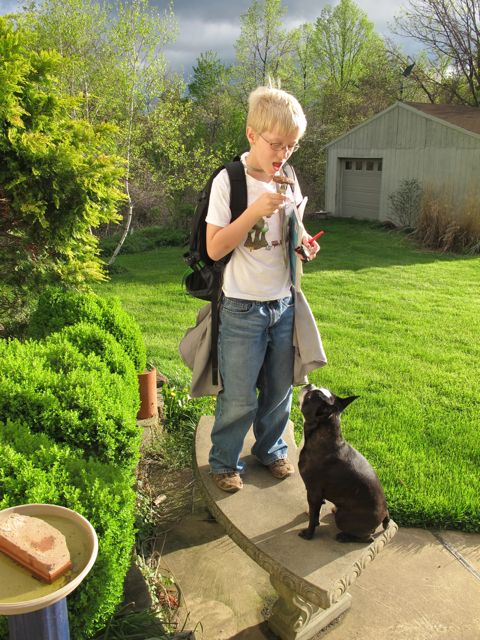
Because you have been on a starvation diet for Chet Baker this winter, I give you Liam, The Sausage Patty, and The Bacon.

Liam was being closely dogged by Chet Baker as he tried to make his way out to the bus stop with a sausage patty impaled on a fork. A walking breakfast, if you will. Liam eats all morning long, from the moment he pops out of bed, singing, until he gets on the bus two hours later. Fresh fruit, cereal, toast, sausage...whatever's around, he eats. I'm kind of dreading his teen years...when he'll doubtless go from 85 lb. to 185...


So Liam tried to get away from Chet by standing on a concrete bench. As if. 


Yes, The Bacon got some sausage.

Sunday, May 8, 2011

Spring Light


Living in spring's paradise. This light regime lasted for about 20 seconds, and then it all went dark. Moments like this are why I carry my cameras everywhere I go. So when I'm smashed by the beauty of a cloud, a landscape, a flower or butterfly, I can share it with you.


So long we waited this winter, and we waited all of March and April, too, for some sunshine, some warmth. It was very slow in coming, but when it finally did, the moments of warmth and light were all the sweeter. Bill and Liam walk to the bus stop, spring's filmy yellow-green shining in the road puddles.


And we dawdle too long, and hear the growl of the bus as it pulls up and idles. Julie the bus driver is unfailingly kind to dawdlers. She knows to wait on these golden green mornings for our little boy to come puffing around the bend.

Because along the way we have been exploring, finding a Carolina chickadee nest  in the driveway box, laden with seven eggs and Hollofil from Chet's toys, just exactly like it was last year. 

It's so good to have the same little neighbors who do the same things year after year.


I am holding out the slim hope that this nest in our meadow belongs to a tufted titmouse. I want to paint baby titmice in the worst way. Must return this week to see who's incubating!


On this morning, we bring our friend John along. John has a cat at home named Gunga Din. I could tell by the way he was holding Chet Baker that he had a cat, without even asking. You don't bunch a Boston terrier up on your shoulder like that! Chet looked a little pained but kissed John anyway. He is that way.


We showed John the proper way to hold a Boston terrier. You let him jump up on your lap and then you give him a half-hour massage, working on the knots in his poor stressed muscles. Of which he has none.


Bill and John walk the driveway, hunting morels


but all we manage to find is chickadee eggs. Another chickadee nest in the backyard, this one still being laid!
And though, being in the yard, she's much closer to the motherlode of Hollofil, she prefers grape bark and rabbit hair and goldenrod fiber.


Individuals all, the birds on our land.  If you're wondering how I got these nest photos, I'm shooting down into our faux birchbark PVC bird boxes. The light comes through the sides, which is one of the things that invasive, nest destroying house sparrows hate about them. House sparrows like deep dark cavities, not nicely lit ones, so these PVC boxes, designed by Steve Gilbertson of Minnesota, are just the ticket where there are house sparrows bedeviling your bluebirds.

Thursday, May 5, 2011

Cooking Morels


The table awaits the feast. Everyone else is out hunting morels; I've got the kitchen to myself. Of course, I already have about 100 morels in the fridge to work with; only a fool plans a feast before picking.


The centerpiece: the glorious bloom heads of Syringa vulgaris "Aunt Lolly." 
Is this the sweetest time of year?


Any good feast starts with heavy cream and butter. At least it does around here, where we ascribe to the "fat doesn't make you fat; carbs do!" gospel. We eat pretty French. To those first two essentials, I'd add shallots. These hard little red onions impart a flavor that's impossible to get anywhere else, and they cook up super soft. So. Start by sauteeing chopped shallots in butter, and when they're soft, add a whole bunch of whipping cream. Like a pint, to feed six. More than you think you'll need, because it cooks down. The beauty of whipping cream is that you can boil it and reduce it. It'll foam up, but rarely overflows the way milk does. Just don't walk away. While it's simmering, add cold butter in small amounts, about a half a stick total. Stir as you add the butter. 

While that's cooking down, start sauteeing your chicken breast, with more butter and shallots. Get the pan good and hot and don't overcrowd it, or the chicken will poach instead of browning deliciously. Just another thing I learned in an afternoon cooking workshop with Chef Dave Rudie. I was an incorrigible overcrowder of sautee pans before I took that workshop. And my chicken breast was always tough and bland. Now it's succulent, and I have a hard time keeping the kids out of it before serving it. They nip in, grab a strip, run out...nip in, grab, run...I love it. This is a properly uncrowded pan.


Chop your mushrooms. I use a kitchen shears. I hardly ever use knives any more. Kitchen shears rock.
That's the lone oyster mushroom on the upper left.
It went into the mix, too.


On the left are the half-free morels, and on the right are the white morels. You cut up stem and all.
It looks like calamari, doesn't it?


Now sautee those in shallots and butter, in the same pan you cooked the chicken breast in. As the drippings rise up from the mushrooms (they're mostly water), pour those drippings into your simmering cream/butter/shallot mixture. Same goes for any excess chicken drippings. Don't throw anything out!
The mushrooms don't have to cook long, just enough to soften and visibly shrink.
Take them out and set them aside, pouring the juices that will collect under them into your cream sauce.

Now comes the top-secret part. To the cream sauce, I add a bloop of honey mustard, a tablespoon or two of Tennessee sourwood honey (it's got a whang to it), salt, pepper, and the Most Top Secret Ingredient:  A chunk of frozen paw paw pulp from last September. I have it frozen in ziplocs and I am very nearly out of it, but it makes a heck of a lovely addition to my cream sauces. ohhhhh yummmmm. It gives the sauce that je ne sais quoi that happens in really good recipes.

Immediately before serving, combine chicken, mushrooms, shallots and the turbocharged honey mustard pawpaw shallot cream sauce and simmer for a couple of minutes to heat everything through.


Serve over rice, with homegrown asparagus, if you've got it. And we've got it.


Droooool.


Our guest John has selected a lovely pink California wine, Bieler Pere et Fils, a rose (it would be so nice if I would learn how to put accents on letters, but I won't) redolent of strawberries, as a fit companion to the mushroom feast. None of us is in the habit of drinking pink wine, but this is really clean, crisp, and perfect, a Wine Shop recommendation. Bill "reads" the label, fabricating a great deal as he goes along. Much of it is a bit rude.


Which Liam appreciates greatly.


Guests await the feast.


Chet Baker is waiting to clean the plates before they go in the dishwasher. He loves him some morel sauce.


 They are going to make me get down out of this chair before dinner. I know it. And I also know they are going to lick their plates. I will not get enough sauce. So I am giving Mether the stink eye so she gives me my own chicken. Because I am fainting from hunger. It smells so delicious!


I will keep my station on John's lap, because guests are the most likely to cave in.


Tuesday, May 3, 2011

Morel Hunting: Turtles and Dogs Like It, Too!

In the exquisite timing of spring, morels come up just as the asparagus is ready for cutting--the last week of April.
This patch has been growing for 19 years and we have more than a dozen big feeds off it each spring. It gives and gives and demands little but good mulching.
Last summer I used endless stacks of newspapers, topped and layered with fresh grass clippings. The clippings, raked off the lawn, held the newspapers from blowing away and disguised them from view. Quite a lovely system!  It all melted into the soil, and the spears were a snap to find this spring. 


Of course the chirren aren't the only people who love hunting morels. Chet Baker comes along. He likes to look for turkles in the morel patches, and we have found three this spring.


Here's the turkle Chet found in our sideyard. We'd never had morels come up there before. What a thrill to find 15 of them raising proud heads in a neglected corner of the yard! and the requisite Guardian Box Turtle to go along with them.


Of course Chet is always on the lookout for squirtles and chiptymunks, too. If there is a log, Chet Baker is on it, scanning the woods. 


Bill spotted this gorgeous old gent just crossing a rotted log in a big patch of morels. 
This is not a coinkydink.


Here is a photo of turtle depredation on a half-free morel. Chunks are bitten out of cap and stem. We are never annoyed at this, nor have we ever considered taking action. In fact, when we find turkles in our patches, we leave a morel in front of them as a gift to eat after we've gone.


How wonderful it is to have both in our woods, and both at the same time.


We only rarely pick turtles up when we find them. We watch them through binoculars and let them think we never saw them, then walk on. We treat them like Hollywood movie stars, play it cool; we don't run right up to them and gawk or ask them questions. Unless one seems to have a problem, and then it gets a full exam.


Aftermath of a fine afternoon, prelude to a feast!


Sunday, May 1, 2011

Morel Hunting


 It is the season
when pallid leathery fingers push up through the sweet wet loam
the glad impudent thumbs of a mycelium hidden for decades below ground
saying yeah spring yeah spring yeah spring
whether anyone notices them or not


 The morels are here.


We notice.

By the basketball hoop, in the sideyard, they emerge 
never expected, always hoped for, making us hoot with joy and drop everything
in the mad scramble to appreciate them.


Oh, hello hello hello!


Morchella the Mad Mushroom Queen dons rubber boots with running gear, straps on binoculars, grabs a mesh bag and is ready to go. You put them in mesh bags so their spores can sow the ground as you walk, swinging it. And then when you rinse them, you save the water and anoint new ground with countless millions of precious spores. This is how you thank them for feeding you.


Such a fine meal they make. This is the white (or yellow) morel, Morchella esculenta. 
Our land also hosts black morels,  Morchella elata, which are smaller and darker but just as delicious.

And then there is the half-free morel, Morchella semilibera, which is more common than either black or white morel on our land, and differs from them in having a pointed cap and a more diaphanous texture (it feels very hollow and flimsy). Upon being bisected, the half-free has its cap attached to the stem for only half its length. And the stem is hollow, and lacks any cottony fibers. This is a very important distinction, to distinguish the edible half-free morel from the possibly poisonous false morel, Verpa bohemica.


 We have a number of nicknames for the half-free morel, none of them family-friendly. However, we are delighted to eat this one along with the white and black morels. They aren't as firm or solid, and get a little limp when cooked, but they still taste fabulous. You have to sautee them. Never eat any morel raw; one ignorant chef served raw morels to his patrons and made his whole restaurant very sick.


We found more than 80 half-free morels in this spring's picking!


  Plus a bonus oyster mushroom, Pleurotus ostreatus, beautifully scalloped. This is one of the bracket or shelf fungi that's wonderfully edible.  And this was the prettiest one I'd ever found. Unlike the morel, oyster mushrooms grow on wood, living, dying, or dead. Here, I've found them on tulip, bigtooth aspen, and sugar maple.


Phoebe and Liam LOVE hunting morels with us. If we see a few coming up, we always wait until the kids can join us to pick them. We just turn the kids loose and stand back. For whatever reason, we all hoot a lot while hunting morels.


Liam was on his way to the shower when Bill found this mess o' morels. So he came out in the altogether to hunt.


Yes, the best things in life are free.