Showing posts with label morel hunting. Show all posts

Thursday, May 5, 2011

Cooking Morels


The table awaits the feast. Everyone else is out hunting morels; I've got the kitchen to myself. Of course, I already have about 100 morels in the fridge to work with; only a fool plans a feast before picking.


The centerpiece: the glorious bloom heads of Syringa vulgaris "Aunt Lolly." 
Is this the sweetest time of year?


Any good feast starts with heavy cream and butter. At least it does around here, where we ascribe to the "fat doesn't make you fat; carbs do!" gospel. We eat pretty French. To those first two essentials, I'd add shallots. These hard little red onions impart a flavor that's impossible to get anywhere else, and they cook up super soft. So. Start by sauteeing chopped shallots in butter, and when they're soft, add a whole bunch of whipping cream. Like a pint, to feed six. More than you think you'll need, because it cooks down. The beauty of whipping cream is that you can boil it and reduce it. It'll foam up, but rarely overflows the way milk does. Just don't walk away. While it's simmering, add cold butter in small amounts, about a half a stick total. Stir as you add the butter. 

While that's cooking down, start sauteeing your chicken breast, with more butter and shallots. Get the pan good and hot and don't overcrowd it, or the chicken will poach instead of browning deliciously. Just another thing I learned in an afternoon cooking workshop with Chef Dave Rudie. I was an incorrigible overcrowder of sautee pans before I took that workshop. And my chicken breast was always tough and bland. Now it's succulent, and I have a hard time keeping the kids out of it before serving it. They nip in, grab a strip, run out...nip in, grab, run...I love it. This is a properly uncrowded pan.


Chop your mushrooms. I use a kitchen shears. I hardly ever use knives any more. Kitchen shears rock.
That's the lone oyster mushroom on the upper left.
It went into the mix, too.


On the left are the half-free morels, and on the right are the white morels. You cut up stem and all.
It looks like calamari, doesn't it?


Now sautee those in shallots and butter, in the same pan you cooked the chicken breast in. As the drippings rise up from the mushrooms (they're mostly water), pour those drippings into your simmering cream/butter/shallot mixture. Same goes for any excess chicken drippings. Don't throw anything out!
The mushrooms don't have to cook long, just enough to soften and visibly shrink.
Take them out and set them aside, pouring the juices that will collect under them into your cream sauce.

Now comes the top-secret part. To the cream sauce, I add a bloop of honey mustard, a tablespoon or two of Tennessee sourwood honey (it's got a whang to it), salt, pepper, and the Most Top Secret Ingredient:  A chunk of frozen paw paw pulp from last September. I have it frozen in ziplocs and I am very nearly out of it, but it makes a heck of a lovely addition to my cream sauces. ohhhhh yummmmm. It gives the sauce that je ne sais quoi that happens in really good recipes.

Immediately before serving, combine chicken, mushrooms, shallots and the turbocharged honey mustard pawpaw shallot cream sauce and simmer for a couple of minutes to heat everything through.


Serve over rice, with homegrown asparagus, if you've got it. And we've got it.


Droooool.


Our guest John has selected a lovely pink California wine, Bieler Pere et Fils, a rose (it would be so nice if I would learn how to put accents on letters, but I won't) redolent of strawberries, as a fit companion to the mushroom feast. None of us is in the habit of drinking pink wine, but this is really clean, crisp, and perfect, a Wine Shop recommendation. Bill "reads" the label, fabricating a great deal as he goes along. Much of it is a bit rude.


Which Liam appreciates greatly.


Guests await the feast.


Chet Baker is waiting to clean the plates before they go in the dishwasher. He loves him some morel sauce.


 They are going to make me get down out of this chair before dinner. I know it. And I also know they are going to lick their plates. I will not get enough sauce. So I am giving Mether the stink eye so she gives me my own chicken. Because I am fainting from hunger. It smells so delicious!


I will keep my station on John's lap, because guests are the most likely to cave in.


Tuesday, May 3, 2011

Morel Hunting: Turtles and Dogs Like It, Too!

In the exquisite timing of spring, morels come up just as the asparagus is ready for cutting--the last week of April.
This patch has been growing for 19 years and we have more than a dozen big feeds off it each spring. It gives and gives and demands little but good mulching.
Last summer I used endless stacks of newspapers, topped and layered with fresh grass clippings. The clippings, raked off the lawn, held the newspapers from blowing away and disguised them from view. Quite a lovely system!  It all melted into the soil, and the spears were a snap to find this spring. 


Of course the chirren aren't the only people who love hunting morels. Chet Baker comes along. He likes to look for turkles in the morel patches, and we have found three this spring.


Here's the turkle Chet found in our sideyard. We'd never had morels come up there before. What a thrill to find 15 of them raising proud heads in a neglected corner of the yard! and the requisite Guardian Box Turtle to go along with them.


Of course Chet is always on the lookout for squirtles and chiptymunks, too. If there is a log, Chet Baker is on it, scanning the woods. 


Bill spotted this gorgeous old gent just crossing a rotted log in a big patch of morels. 
This is not a coinkydink.


Here is a photo of turtle depredation on a half-free morel. Chunks are bitten out of cap and stem. We are never annoyed at this, nor have we ever considered taking action. In fact, when we find turkles in our patches, we leave a morel in front of them as a gift to eat after we've gone.


How wonderful it is to have both in our woods, and both at the same time.


We only rarely pick turtles up when we find them. We watch them through binoculars and let them think we never saw them, then walk on. We treat them like Hollywood movie stars, play it cool; we don't run right up to them and gawk or ask them questions. Unless one seems to have a problem, and then it gets a full exam.


Aftermath of a fine afternoon, prelude to a feast!


Sunday, May 1, 2011

Morel Hunting


 It is the season
when pallid leathery fingers push up through the sweet wet loam
the glad impudent thumbs of a mycelium hidden for decades below ground
saying yeah spring yeah spring yeah spring
whether anyone notices them or not


 The morels are here.


We notice.

By the basketball hoop, in the sideyard, they emerge 
never expected, always hoped for, making us hoot with joy and drop everything
in the mad scramble to appreciate them.


Oh, hello hello hello!


Morchella the Mad Mushroom Queen dons rubber boots with running gear, straps on binoculars, grabs a mesh bag and is ready to go. You put them in mesh bags so their spores can sow the ground as you walk, swinging it. And then when you rinse them, you save the water and anoint new ground with countless millions of precious spores. This is how you thank them for feeding you.


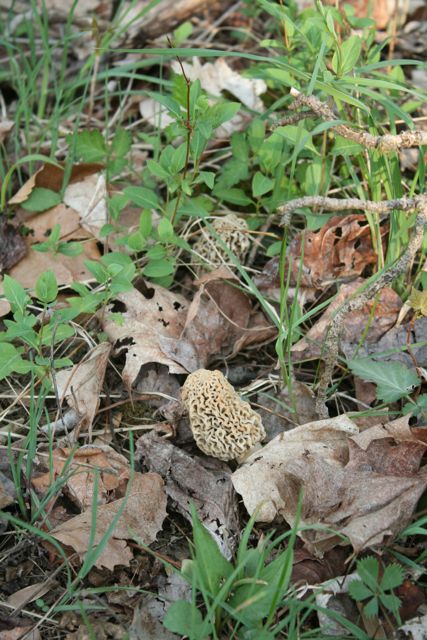
Such a fine meal they make. This is the white (or yellow) morel, Morchella esculenta. 
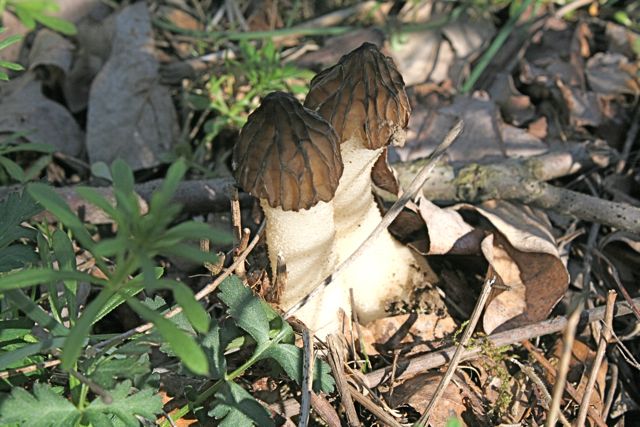
Our land also hosts black morels,  Morchella elata, which are smaller and darker but just as delicious.

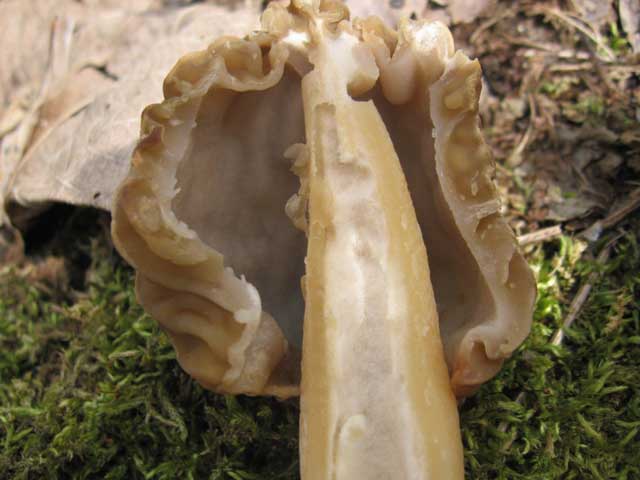
And then there is the half-free morel, Morchella semilibera, which is more common than either black or white morel on our land, and differs from them in having a pointed cap and a more diaphanous texture (it feels very hollow and flimsy). Upon being bisected, the half-free has its cap attached to the stem for only half its length. And the stem is hollow, and lacks any cottony fibers. This is a very important distinction, to distinguish the edible half-free morel from the possibly poisonous false morel, Verpa bohemica.


 We have a number of nicknames for the half-free morel, none of them family-friendly. However, we are delighted to eat this one along with the white and black morels. They aren't as firm or solid, and get a little limp when cooked, but they still taste fabulous. You have to sautee them. Never eat any morel raw; one ignorant chef served raw morels to his patrons and made his whole restaurant very sick.


We found more than 80 half-free morels in this spring's picking!


  Plus a bonus oyster mushroom, Pleurotus ostreatus, beautifully scalloped. This is one of the bracket or shelf fungi that's wonderfully edible.  And this was the prettiest one I'd ever found. Unlike the morel, oyster mushrooms grow on wood, living, dying, or dead. Here, I've found them on tulip, bigtooth aspen, and sugar maple.


Phoebe and Liam LOVE hunting morels with us. If we see a few coming up, we always wait until the kids can join us to pick them. We just turn the kids loose and stand back. For whatever reason, we all hoot a lot while hunting morels.


Liam was on his way to the shower when Bill found this mess o' morels. So he came out in the altogether to hunt.


Yes, the best things in life are free.


Wednesday, April 29, 2009

Morel Madness

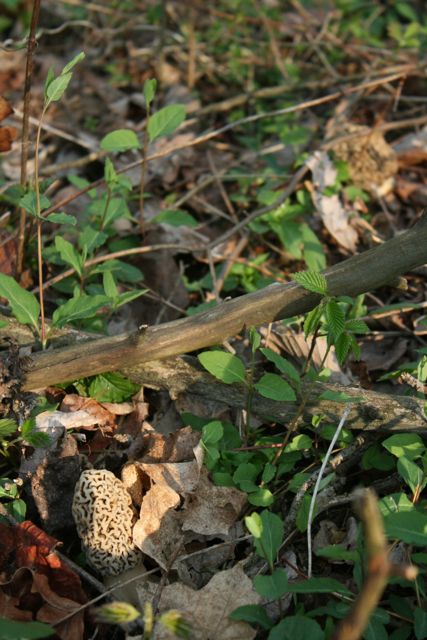
There are two white morels in the photo. Can you find them?

It's MOREL TIME. Yes, I am shouting. I love MOREL TIME. I will say that, with the weather going from Februaryine conditions to Augustine in the space of 24 hours, it's a little tough on the morels. Bill and I went out twice a day, checking our honeyspots, looking, looking, finding nothing. And then I was riding the lawnmower, just pootling along, when I saw three wrinkled beings lined up right along our driveway. AGGH! Morels.

Here I am in the thrill of discovery. The tattoo on my arm is temporary. It is a muscle car with flames shooting out its butt, which I applied to my skin as inspiration, because I needed to empty the greenhouse and plant the vegetable garden in three days. Which I did. As you can tell from my stunning farmer sunburn.photo by Phoebe Linnea Thompson

Not only did I empty the greenhouse, but I potted five large hanging baskets and nine planters, dug out and distributed reechy compost to all my garden beds, weeded several beds, rototilled the garden, planted the beans, glads, and tuberoses, and mowed the lawn. It was a heck of a weekend. Pretty much perfect by Zick standards, except that Bill wasn't here to share the joy.

On Saturday afternoon, when the lawn was mowed, I called to Phoebe to come join me in a search for more morels. We decided to hit new ground, near where I'd found the trio of monsters pictured above.

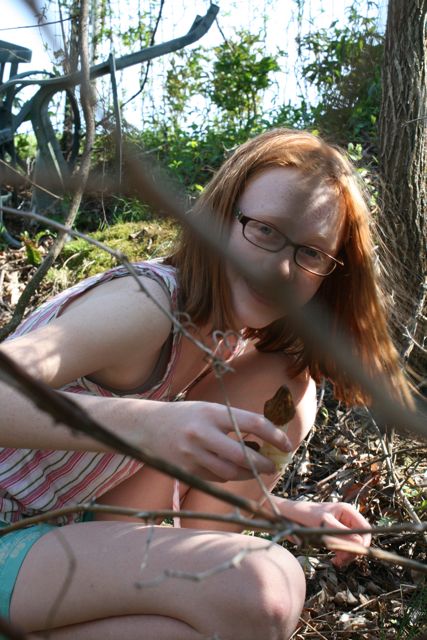
Phoebe finds her first one. The twig across her face doesn't hide her excitement.
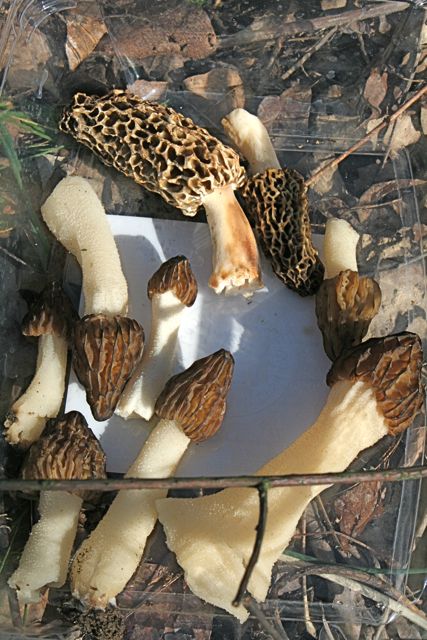
At this point I should say that we found two different species of morels. The white, or yellow morel Morchella esculenta is the most highly prized for its taste and texture. The two fabulously wrinkled, paler specimens at the top are white morels. They look more like a proper mushroom to me.

All the rest with the smaller brown caps are half-free morels, Morchella semilibera. They're perfectly good to eat and taste wonderful, but they don't hold up quite as well to cooking as does M. esculenta, being sort of gauzy and less substantial in texture. They're called half-free morels because the cap is attached to the stem halfway up, leaving the cap hanging down over the stem for half its length. White morels' caps are attached to the stem at the base. Both edible species have a hollow stem, which is the diagnostic characteristic that tells you they are safe to eat. If you find a morel that, on cross section, has a stem filled with white fuzzy hyphae, you've probably got Verpa bohemica, the False Morel, which you DO NOT want to eat.

Here is the yummy half-free morel, with its hollow stem, and cap connected halfway up. The stem has white pimples on the inside, but not cottony fibers:

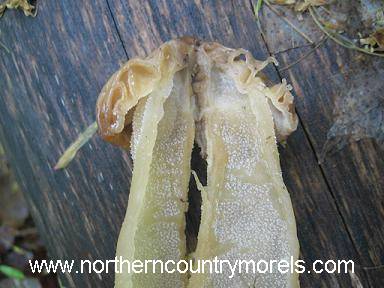
And here is Verpa bohemica, the False Morel, with its stem full of white cottony hyphae, its cap hanging free and attached only at the very top, and its nasty poisonousness. Don't eat this one.

These photos lifted from Northern Country Morels, a wonderful web site full of wisdom and warnings.

Remember: There are old mushroom hunters, and bold mushroom hunters, but there are no old, bold mushroom hunters.

One of the half-free morel's common names is "peckerhead," and so are they called on Indigo Hill.
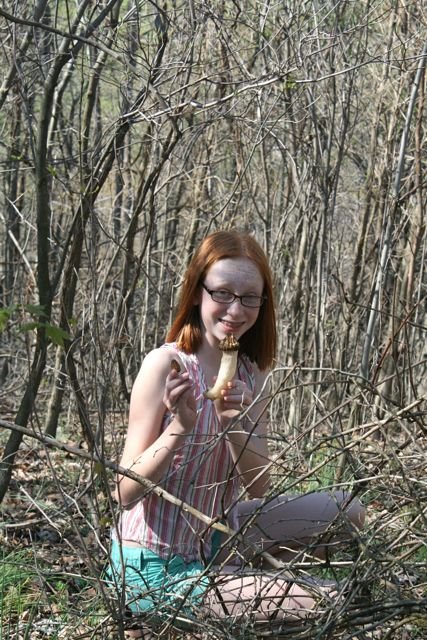
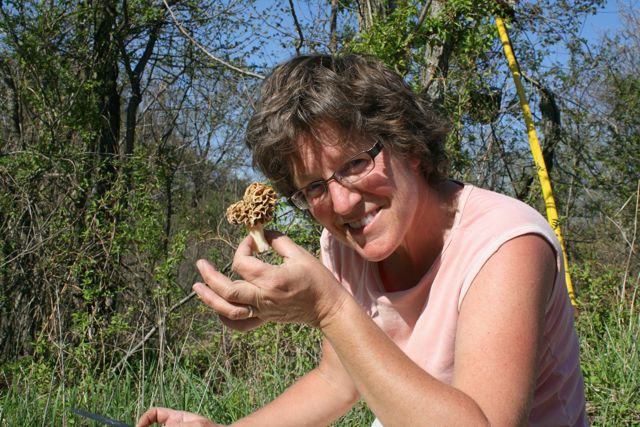
Phoebe gave me permission to use this picture of her holding a large half-free morel. Yes, she is her mother's daughter (and her father's daughter) through and through. Which is to say, irreverant and pleasantly evil, even at twelve. Heck, she was that way at three.

Farther out our orchard, near the rotting apple stumps, we found a sweet spot full of delicioius white morels.

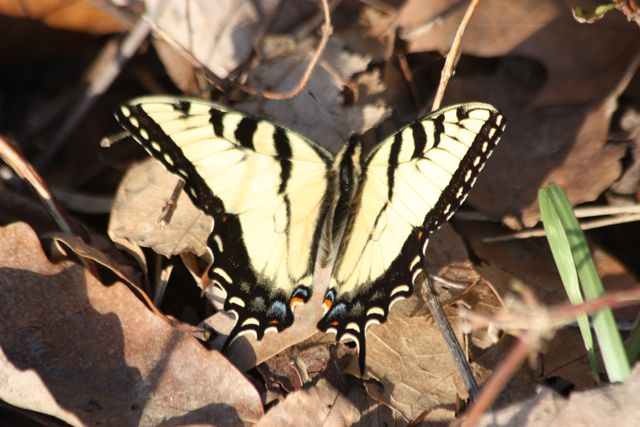
A tiger swallowtail, meet companion to the morel hunter. Look for them when the tigers are first flying in spring, when the fiddleheads push up from the earth.


Thanks for coming morel hunting with us.photo by Phoebe Linnea Thompson

We love you all, but this is about as close as you're going to get to our happy hunting grounds. Morels bring out the bad, possessive and evil in us.