So I'm floating along with my camera, marveling at all I've seen in a few hours of doodling around in my lil' peapod canayak. I just can't get over the array of active nests I've found. Just goes to show you what birds can accomplish when mammalian and reptilian predation is controlled by oh, four or five feet of water.
This snag intrigued me, just because the Virginia creeper framed the cavity so beautifully. I didn't see a vine running up the tree, and because it was standing in several feet of water, any vine coming from the ground would be drowned. I figured the creeper had rooted in the cavity. I circled the tree, shooting, and it wasn't until I saw the photo on the camera screen and blew it up (trying to figure out where that vine was coming from) that I saw that the tree hid another treasure.
There was a nice nest inside the cavity, which could have belonged to a robin, but I suspected it might have been built by an eastern kingbird, because there were gobs of them around. Would a kingbird build in a cavity like that?
Well, would you?
I might.
More discoveries: I saw some stuff sticking out of the top of a rotten stub, which resolved into nesting material, and a setting kingbird. Well!
Well, hello, Missy! I'll pass by--don't you worry or get up, OK?
Luckily for you, she did leave the nest for a moment. I say that because this gives me a chance to tell you how to sex a kingbird. See the gray wash on her breast? That's a female. Males have a clean white breast. Nice of them to have a little dimorphism, just enough to make it fun for a birdwatcher.
But my favorite kingbird nest of the day (and this was more kingbird nests than I'd seen in my life, for goodness' sake!) was the last one. I saw a beautiful kingbird fetched up on a snag, and shot a photo of it.
We bird photographers can have tunnel vision--we're trying so hard to get the bird in focus and framed that we often overlook what's around the bird. See anything interesting in this photo?
Yeah, it took me awhile, too. Sweet! There were two little heads bobbing in the nest.
It was a beautiful end to an incredible day on the water. All I want to do is go back to West Virginia's North Bend State Park. You can lose yourself at a place like that.
One good outing in a boat can be absolute magic for the soul. Forget chicken soup. I need the sound of trickling water under a canoe hull, the gentle rock of a boat on calm water.
A couple weeks ago, we mounted an expotition to North Bend State Park, not far over the West Virginia International Boundary with Ohio. About nine years ago, a dam went in, making a long, meandering flooded lake with lots of fascinating elbows and appendices to explore.
David and Mary Jane, Chet Baker's West Virginia parents, alerted us to this place, and all the birds they'd found nesting there made us anxious to explore it. So they brought their huge aluminum canoe, and graciously took our kids in it, while Bill and I zooped around in our one-man canoes.
Get a load of these reflections.
It was immediately clear to us as birdwatchers that we were entering a gallery of cavity-nesting birds the likes of which we'd never experienced.
For the flooded trees all died at the same time, and this made for easy excavation by flickers, red-bellied, hairy and downy woodpeckers.
Flickers, in fact, were going nuts all around us, courting and fighting. These two males engaged in some terrific stunts and dances, vying for a single female. See their black malar marks, or "moustaches?" Those small black dashes on the side of their faces (not the breast crescent; both sexes sport that) mean they're boys.
The males kept engaging each other, approaching, posturing with bills erect. There was a whole lot of woika woika woika-ing going on.
The female flicker's the top bird in this photo.
Very noisy and amusing, they were. What a treat to see flickers breeding--outnumbering the starlings, which compete for the cavities the woodpeckers dig. This is one of North America's most ornate birds. All the spots and dashes of jet black on warm brown plumage--they wouldn't really need the golden underwings and tail, or the white rump, or the gray toupee, or the little vee of scarlet on the nape...but flickers have it all.
Sometimes when I see a flicker on the ground I'm reminded of Africa's beautiful hoopoe, which is why I sometimes call flickers the American hoopoe. But usually only to myself or to Bill, because most people have no idea why I'm calling a flicker a hoopoe.
Good grief, they were spectacular. I love this photo--it captures the crazy antics we witnessed as the three birds chased and swirled above the mirrored water. Yes, that's gold in the spread wing of the lower bird. Oh, for a bigger lens, better light, closer approach. But you get the idea.
But flickers weren't the only woodpeckers nesting in the flooded forest of North Bend State Park. There were red-bellied, hairy and downy, pileated too. And then there was the most beautiful woodpecker of all...Bill's totem bird.
The place is absolutely lousy with red-headed woodpeckers. I hope you're swooning, because we sure were. Red-headed woodpeckers are durn rare any more. Why the loveliest woodpecker must be our rarest...sigh.
I've just returned from a road trip to West Liberty, West Virginia, just north of Wheeling. Three weeks ago, I visited a Zickblitz upon the campus of West Liberty University,
giving a library talk, a luncheon talk, a Hughes public lecture, and hanging 46 of my paintings from Letters from Eden in the school gallery. (Art professor Robert Villamagna and I hung them all in about two hours using a only a hammer, nails, a length of string and our eyeballs, the finest measuring device known.) There was a public opening, and there were a couple of dinners, too.
All this happened over a four-day span. It was really fun. I talked a lot, interacted with students and faculty, stayed in the fabulous alumni house on campus:
Yes, that'll do. Just fine, for a few nights.
I felt so honored to be invited, so delighted to share some stories and paintings with interested, like-minded people. I love being caught up in the current trend of honoring area artists and writers. It's smart; it makes sense, and I thank English professor and Hughes Lecture Chair Peter Staffel for thinking to invite me. Let's face it: it's more affordable than bringing someone in from another state or foreign country, and it sends a message to students that there are creative people worth engaging all around us. That sends a message that they have permission to grow up to be one of those people; that they don't have to flee their homes in order to make their mark. If nothing else, at least I can offer them a living, breathing example of someone who lives in Appalachia and writes and paints about that life.
I can function pretty well with a lot of hubbub, and I enjoy it, but there comes a point when it's time to recharge the batteries. I'm a textbook introvert. When called upon to be an extrovert, I can rise to the challenge, but my resting mode is introvert. I'd guess that most writers are introverts, and many, if not most, artists.
Although there's kind of a stigma associated with being an introvert, I don't believe that it's any better to be an extrovert. It's just different. As Murr points out, it's about from whence you draw your energy. Extroverts draw it from other people, from the hubbub. Introverts draw it from within, and they must flee the hubbub to recharge.** Extroverts accomplish a ton of good things, giving of themselves on boards and committees, gathering others around them, sharing their vision. But I think that a lot of good things come from people who like to work and create by themselves. If the world was composed of only extroverts, we'd all go crazy. If we were all introverts, it would be a really quiet, boring place. We balance each other, even if we don't always understand each other. Right, Dearest?
**thanks for this crystallization, Murr.
Along about the last morning of my stay, it was time to walk. I wished I had Chet Baker with me. I've found that being alone with him is better even than being alone. He fits perfectly into that special space where I'm delighted to finally be still and quiet and alone, but I'm just a tiny bit lonely, too. He doesn't analyze or criticize, go off on tangents or make any background noise. He just keeps me company.
I drove north up Route 88 toward Bethany and took the first right turn I found, which is Garrison Run Road. I had seen it on my first evening and made a mental note to check it out. Oh, was I glad I did.
To my eye, this looks like a place which has been strip mined and recovered. I may be wrong, but I think that's why it looks like it does. Which is pretty ironic, because I found it heartbreakingly beautiful with its forest dress taken off. I don't know. Maybe it's just hayfield. Let's call it hayfield. That's a mighty old barn. Maybe it pre-dates strip mining.
There is actually a palm warbler in the middle of this shot. I didn't bring my telephoto lens, d'oh! because I didn't think I'd have a chance to sneak off and be in nature. There were migrant meadowlarks singing their little hearts out, too. Oh, what a balm that was to my ears.
There was a big clump of foxtail growing up in the bend of the barn roof, catching the morning sun. I'd never seen that before!
In this landscape, you can see some of the taller buildings on campus, nestled in the forest. It's such a beautiful place to go to college. If I studied or worked there, I'd come to Garrison Run as much as I could. I wondered if any of the students knew to come here to get all fixed up again.
Soon I plunged down into the woods, leaving my car a couple of miles behind. It was so golden, so alluring in the morning light. I could have walked down that road all day.
Oh, pardon me! I didn't realize...
May I ask what exactly you two are doing?
They weren't talking, and I still haven't figured out what these two sugar maples, which appeared to be from separate root systems, were up to. Whatever it was, it was pretty sexy, so I left them in peace.
I walked awhile longer, having a conversation with a redtail and some song sparrows, and then it was time to go back to the surreal world.
As I came up out of the woods, the light played across the hayfields
and the chicory set its blue up against the sky and asked me to pick which I liked more
and neither of them won, really, because they were both beautiful in their own way, and I loved them both the same.
Heartfelt thanks to West Liberty University, and especially Peter Staffel and Robert Villamagna for making it all happen.
We had very little butterfly weather in West Virginia. Butterfly weather is warm and sunny. When it rains and is cool and misty, butterflies hide away. When the sun peeks out, so do they--it's like magic, like suddenly walking into the movie "Snow White," with butterflies parting in front of you.
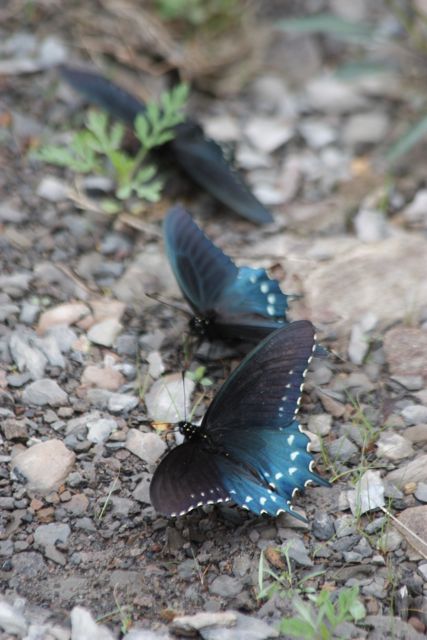
I managed to snap a few butterflies in the hour or so of sunshine we enjoyed. Pipevine swallowtails were the most obvious about. They're distinguished by that bewitching iridescent teal-blue hindwing. Beyond that, the iridescence suffuses the forewing and body. The pipevine swallowtail is one elegant bug.
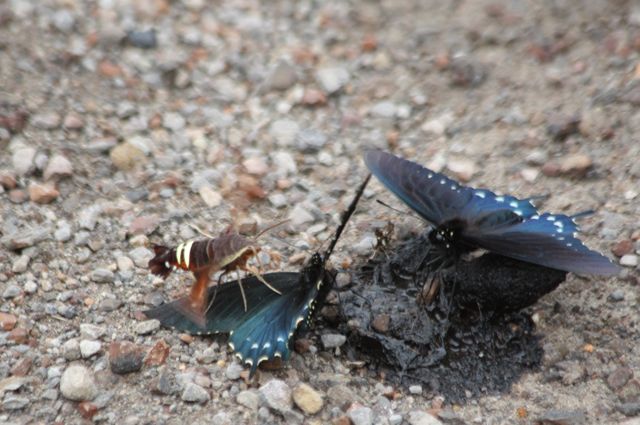
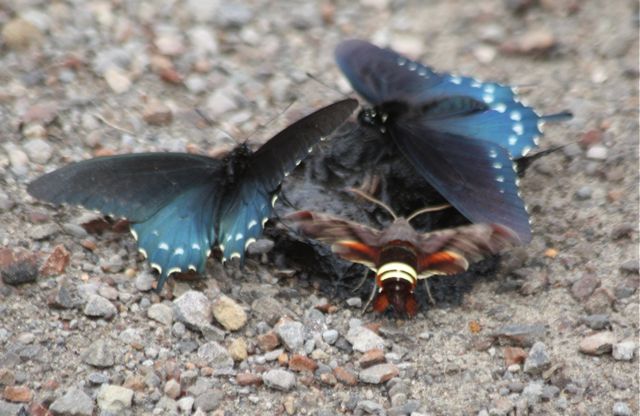
So we're watching these butterflies puddling (imbibing phosphates and other essential minerals in mud), and this thing that looks like a flying crawfish shows up. Eek! It's walking on the pipevine! What is it?
Ah. It's a Nessus Sphinx, a kind of hawkmoth, Amphion floridensis. Its brood plant (what the caterpillars eat) is Virginia creeper, grape, or porcelainberry. Lovely.
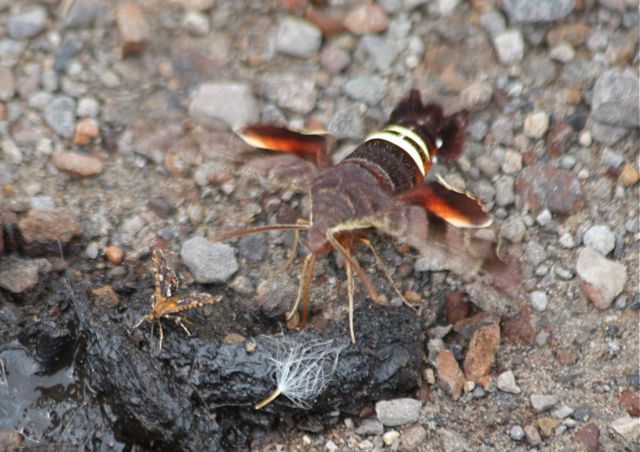
And exceedingly weird. Here, its forewings are blurred and nearly invisible, enhancing the crawfish similarity.
Not only that, but there's a little bitty microlep, another moth that looks like a miniature. See it just to the left of the giant sphinx? With a dandelion seed for scale? Teeny. Maybe somebody will know what it is, but I'm not holding my breath. All I know about it is: it likes skunkdoo.
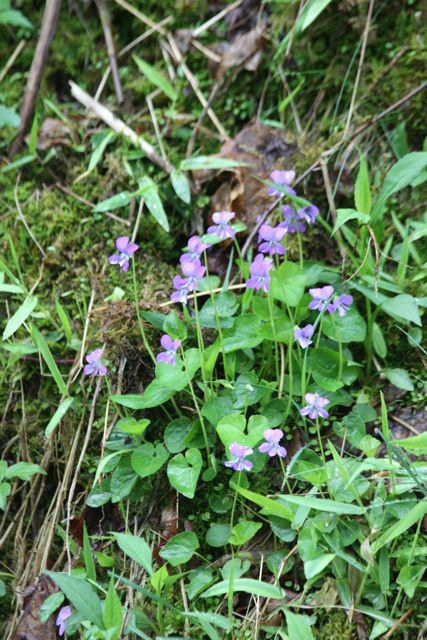
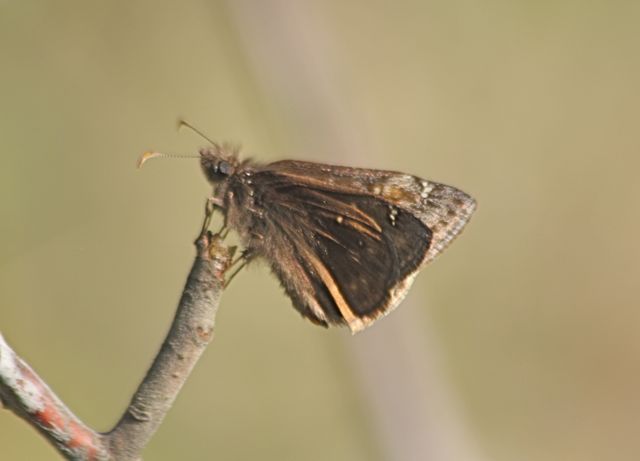
On to more wholesome things. Here's Swamp Blue Violet, Viola cucullata. I like the common name of cuckoopint. A Juvenal's duskywing, dark harbinger of spring. You can tell it from Horace's by the two pale dots on the upper rim of the hindwing.
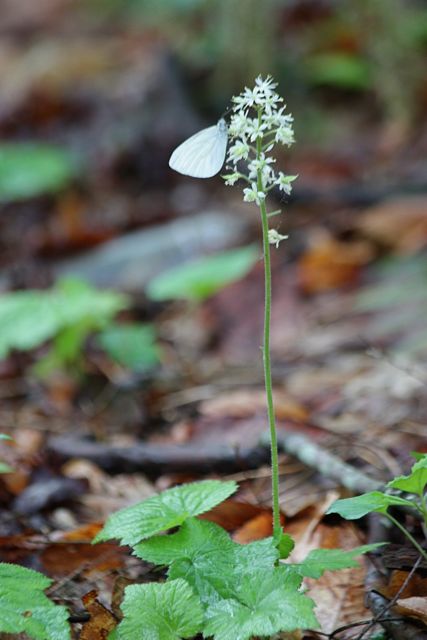
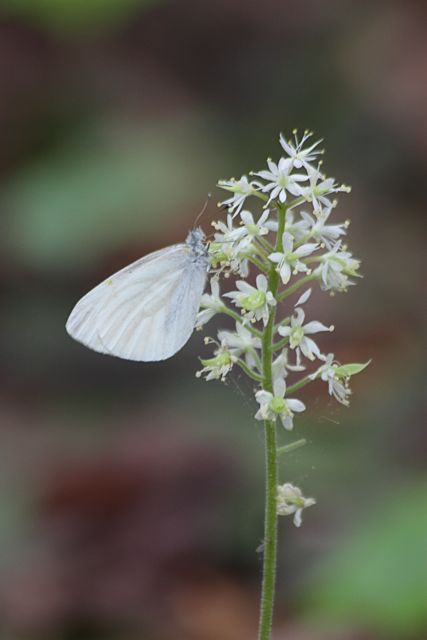
And for me, the prize of the day (other than spending part of it with Tim Ryan) was a lovely West Virginia White. How appropriate for this rarish little butterfly to show up, nectaring on foamflower, Tiarella cordifolia, at the end of our Muddlety trip.
This lovely little thing is distinguished by its grayish shading on the veins of the underwing. It's a Pieris, like the cabbage white P. rapae, but it's P. virginiensis.
It usually rains at the end of April and beginning of May in West Virginia. When I was corresponding with other members of the nature blogging Flock about the trip, I advised raingear, lots of it. And this turned out to be a very wet festival.
Which was something to deal with, but not a problem. People who love warblers are happy folks. They kept their sunny attitude.
The flowers were still lovely. Golden ragwort and cranesbill (wild geranium). The magnificent large tree, Fraser magnolia, Magnolia fraseri.
The birds' colors were a bit compromised by the fog and rain. In sunlight, cerulean warblers are sky blue.
They still sang, if a little less persistently. Their black necklaces were all that distinguished them; their stunning blue backs would have to wait for better light, better days.
It was all very ricepaper and watercolor, very Japanese. Even a male scarlet tanager looked grayish in this light.
Well, it's shaped like a tanager... Photo by Nina.
The direction of light became paramount in getting a decent look at a bird. This northern parula cooperated for a nanosecond, showing his sunny breast.
As we walked, I noticed a female eastern towhee as she burst frantically from the ground. She appeared to have been trying to stay still, then lost her nerve. I knew that meant she was on eggs somewhere nearby. I split from the group and walked carefully along the foot of the bank.
And found the nest, using a laser pointer to show it to the festival participants. Photo by Nina.
Four white eggs, speckled with rust, well hidden in a grassy nest tucked into the bank, under a big multiflora rose. I wish her well.
Some black rat snake eggs were less fortunate. Examining these, I decided that they had been washed out after having been buried by the female snake last summer. The eggshells were unpunctured, but there was nothing inside. So it wasn't a predation event--it was a dessication event.
Red efts (the wandering, terrestrial, juvenile form of the red-spotted newt) were easier subjects than birds.
The smallest red eft I'd ever seen enchanted Nina. I'm sure he'll make an appearance on her blog, Nature Remains.
Katdoc joined her in the photoquest. Katdoc is geared out, full birding plumage.
Nina has ferocious focus. She folded up like a tripod and became one with the newt.
One of Nina's many gifts is looking very closely, and waiting.
Everyone moved on, which is just what Nina needed.
And she became a rock in the road, and captured the eft without touching it.
As Nina and I walked the last bit of Spruce Run Road, loosely known at the festival as Muddlety, we marveled at the abundant life all around us--prairie and blue-winged warblers, chat after yellow-breasted chat, redstarts and hooded warblers, the federally threatened cerulean warbler, scarlet tanagers, and everywhere the flutes of wood thrushes. A tear coursed down Nina's cheek, then another. We had both seen the coal company permit sign about halfway up the road, that, to those who know its significance, means that this entire woodland--all this habitat, all this mountain--is about to be blown up, never to be woodland habitat again.
When you flip a light switch on, there's a 50 percent chance that the energy you're using comes out of what used to be a mountain in West Virginia. Blowing up the richest and most diverse forest in the US--leveling these mountains-- to get the coal underneath it is not a sustainable way to get energy. It is insanity itself. It buries the streams, chokes the rivers and poisons the people. Please, please watch this five-minute video. Maria Gunnoe says it so much better than I ever could. And if you're moved to action, go to the Ohio Valley Environmental Coalition web site and see what you can do to stop this abomination. Muddlety probably won't survive, but there are so many more equally beautiful mountains--and communities, streams, rivers and lives-- the coal companies are planning to destroy.
Watch, then go. Keep spending your ecotourism dollars in West Virginia. All profits from the New River Birding Festival go to environmental education in local schools--a slow but, we hope, ultimately effective way to shout STOP THIS MADNESS!! Thank you.