Showing posts with label Bat rabies. Show all posts

Wednesday, March 31, 2010

What Happened Next


I'm not good for much today but burning trash and doing laundry, of which there's always a lot. A lot has happened since my last post thanking everyone who donated to the Zick Health Fund. This whole bat experience has been like riding the Wild Mouse, with sudden jags left, right and backward. I'll be honest: having it unfold publicly has been painful. There are many things I'd rather do than tell this story to thousands of people. But doing what I most long to: suddenly going offline, crawling in bed and pulling the covers over my head for oh, say a week-- isn't an option either, especially when my readers are offering up their good wishes, love and support.

So here's what happened. On February 13, I took in another bat from the same living room where Dee Dee was found. It was a male, smaller and more delicate than Dee Dee. He looked and acted healthy, except for a large swelling on the right side of his face that involved his cheek and ear and almost closed his eye. It looked like a bite, perhaps, something that isn't unexpected in a bat colony. It scabbed over and healed, but the ear was permanently damaged. In this photo, taken March 28, 2010, you can see that there's a big chunk missing from the lower border of Darryl's ear, and his tragus is shrunken to just a little nubbin in the lower ear.

In the photo below, you can appreciate his good ear. The tragus is the little fingerlike projection in the lower outer ear. The tragus and all the delicate ridges and folds of the bat ear help channel ultrasonic pulses to the inner ear where they need to go. Like all wild things, a bat must be virtually perfect in order to survive in the outdoors. That's a lesson that wildlife rehabilitators, me especially, have to learn again and again. You might recall Avis, the hand-raised eastern phoebe who didn't make it. I sure do.
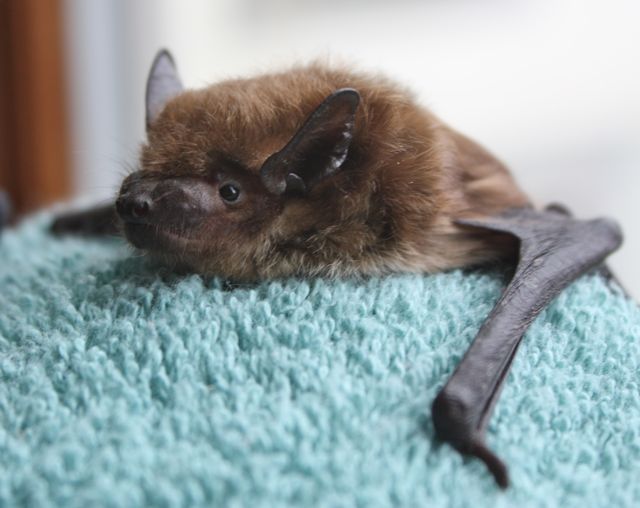
I didn't find out until yesterday at the Ohio Wildlife Center that a damaged ear renders a bat, which forages and gets about using echolocation, permanently unreleasable. So hold onto that thought, bummer that it is, because it will help with what comes next.

I put Darryl in with Dee Dee and they got along great. It was so nice to know they could be together, to wait out the rest of the winter. I had visions of releasing them together. I had visions of bat children, especially when I saw the towels rocking rhythmically the first night they were together. That's bats for you. They're the sexy little beasts.

Some bats in captivity feed themselves out of dishes from the get-go, like Dee Dee.

And some, for reasons unknown, never get the hang of crawling down to their dishes for food and water. After about five days it became apparent that Darryl wasn't eating --he became torpid and unresponsive. Once I got his little engines up and running again, I tried to teach him to self-feed, with little success. He reached out and grabbed a couple of worms on his own, but he clearly preferred catered meals. We went to school, but Darryl decided not to graduate.

So I finally gave up and began feeding him by hand, something we both enjoyed. I really dug communing with Darryl every afternoon. I had to feed him before it got dark, because he got really jiggy then, being a bat and all. Uppity. Squirmy and snarly.

photo by Shila Wilson.

Bats are messy eaters. They make a lot of noise crunching down their mealworms, and mealworm heads and tails fall from their tiny jaws. They're also messy drinkers.

Because Liam loves to get in and help, and because he adored the bats, for several evenings I let him help me feed Darryl from the end of a long bent tweezers. He never touched or handled Darryl; he just fed one mealworm after another into that little mouth while I held the bat, and he was really good at it, better than I was. He could get them lined up just right and knew just when to release the tweezers.

photo by Shila Wilson

Along about St. Patrick's Day, Darryl spluttered while I was giving him water out of a dropper, and a droplet of water landed on Liam's cheek. At the time, I quizzed him sternly on where the water had gone, checked for any abrasions, began to worry, and the more I thought about it, and the more I learned about bats and viruses, the more troubled I became. Liam said that only one droplet landed on his cheek, and nothing went in his mouth or eyes (he wears glasses). We needed to be sure that none of Darryl's saliva contacted a mucous membrane. But we couldn't be sure. We could never be sure. Maybe there was a tiny droplet. And maybe Darryl was carrying rabies. And I didn't sleep much from then on. I'd look in the mirror in the bleary mornings, and I couldn't recognize myself. Even my hair was different--sticking up and out in all directions. Who is this puffy haint, staring back at me with red-rimmed eyes?

I thought that quickly getting both me and Liam pre-exposure rabies vaccinations would protect us, so I moved rapidly down that path. I asked you for help, and you responded magnificently. But that turned out to be a blind avenue. I am very grateful to virologist Tim Winship and faithful friend and veterinarian KatDoc "I hesitate to ask this, but why..." for gently helping me understand what I really needed to do. In a situation like this, friends like Tim and Kathi are beyond value. What happened to Liam constituted a potential exposure to rabies virus, so he would need post-exposure shots (much more expensive and involved than pre-exposure vaccinations) should Darryl test positive for the rabies virus. Oh, dear. Oh, no. And by the way, so would I. At that point, I was well past caring about me. I'd gotten us into this terrible mess; I deserved whatever awful thing happened. I could only think of my little boy.

I couldn't put our sweet Liam through those shots needlessly. They can be painful, and they're terribly expensive ($12,000). Problem: You can't test a live animal for rabies. You have to look at its brain tissue for the virus.

I will condense the heartache, worry and agonizing process of coming to the decision to euthanize and test Darryl so we'd know for sure if those post-exposure shots were necessary into two words: pure hell. When the Lord handed out reverence for small lives, he dumped the whole bucket into my heart. As my dad always said, "You've got your priorities backwards." Being built backward, it took me a weekend to get my priorities straightened out, and take this little animal I dearly loved to Columbus to be put down and tested for rabies.

If the bat tested negative, Liam wouldn't have to get ANY shots. If Darryl was rabies positive, well, we'd cross that bridge when we came to it, because we'd have to figure out who else might have had even a trivial exposure. Bill, Phoebe, me, Liam; others in Bill's family, all of us perhaps slated for post-exposure prophylaxis at $12,000 a pop. Can you take a chance that you didn't somehow inhale something as you were peering at the cute little bat you didn't know was rabid? Rabies is unforgiving, unequivocally fatal. I couldn't sit around with my head in my hands. I had to act, and act fast.

So on Monday, March 29 I packed up Dee Dee and Darryl and a sharp-shinned hawk who couldn't fly and drove my odd little ark to Columbus, to the Ohio Wildlife Center, to have Dee Dee and the hawk taken into their capable care. They also did me the service of putting Darryl down.

I sat in the OWC's tiny reception area for the better part of an hour, desolate, and watched through tears as a parade of citizens came through with animals and birds, to be met by kind volunteers and staff. A couple with a road-killed red-tailed hawk. Too beautiful to leave on the highway, I guess. Another couple with a fox squirrel contained in a trash can, its hind legs dragging behind it. Too sad to leave crawling about under the feeder. A nice woman with a hopeful smile and a wingless, tailless cardinal that she'd doubtless pulled out of a cat's jaws when it already constituted a meal. Too dreadful to leave to the cat to finish. A couple of raccoons bundled in towels. Who knows what their story was. I was staggered by the seemingly endless supply of sad cases and nice hopeful people, by the kindness of the OWC staff and volunteers. I was hit hard by the reality that I, with my two bats and my grounded sharp-shinned hawk, was just one of far too many desperately needing their immediate, free help.

I am so very grateful that OWC exists and cares and works around the clock to try to get some good out of all the sad carnage people, their machines and their pets visit on wild animals. They've taken in and cared for over 36,000 creatures since 1984. The Ohio Wildlife Center is 2 1/2 hours away from me, but it is my closest and only option when a creature needs surgery or I need expert advice on its care. I have leaned on them too many times.

Director of Animal Care, Lisa Fosco, looked at Darryl's ear and matter-of-factly declared that with impaired echolocation abilities, he'd be unreleasable anyway, which made me feel just a little bit better about the decision I'd had to make. She left the room and after awhile came back with a little Ziploc bag with Darryl wrapped in paper towels inside it. I filled out a possible rabies exposure report form, put it in the bag, and drove it to the Columbus Department of Health's laboratory outside Reynoldsburg. As I circled around the compound of imposing brick structures, I saw a man with a cattle car and asked him if he knew where the rabies lab might be. He opened the trailer door, revealing a dead cow, and said, "I hope this is it, because I gotta get this cow tested for rabies." Eep, eep, eep.

Cows, I understand, come down with rabies more than you'd think because when they see an animal in distress, say a bat crawling through the grass, they get curious and often sniff or lick it, getting bitten in the process. Bless their hearts.

Reeling a little from that encounter, I drove away and finally found a promising looking door. I rang the buzzer and a thin man appeared and led me, still carrying my little bag, to a lab covered with biohazard signs. The heavy steel door opened and a very large man with latex gloves, a shaved head and a black goatee nodded and took my little bag. "Got a bat there?" He told me that if all went well I'd hear from him the following afternoon. Which is today, as I'm writing this, the phone inches from my hand. I've tried, but I can't do anything else but write this and wait for the phone to ring.

And it just did. Darryl's test came back negative for rabies.

Good night, sweet leather-winged boy. I will hold my Liam all the closer for having loved you.


This afternoon, I start my pre-exposure vaccinations, because fools like me need more than angels, virologists and veterinarians to look after them.

Sunday, March 28, 2010

Ring of Fire

Love is a burning thing
And it makes a fiery ring
Bound by wild desire
I fell into a ring of fire

I fell into a burning ring of fire
I went down, down, down and the flames went higher
And it burns, burns, burns, the ring of fire
The ring of fire

The taste of love is sweet
When hearts like ours meet
I fell for you like a child
Oh, but the fire went wild

I fell into a burning ring of fire
I went down, down, down and the flames went higher
And it burns, burns, burns, the ring of fire
The ring of fire

"Ring of Fire" by June Carter and Merle Kilgore
Recorded by Johnny Cash March 25, 1963--47 years ago almost to the day!

For the past few weeks I feel as if I've been neck deep in a big black cauldron, a slow woodfire getting hotter beneath me (I have a vivid and politically incorrect Looney Toons image in mind of the little grass-skirted cannibals with bones in their hair dancing around me). As you may know, I generally write my blog essays well ahead of actually posting them. It's mostly a temperamental thing, a perfectionist's way of making sure that what gets posted is close to what I really wanted to say. But I also post ahead because life is strange and it takes lots of twists and turns, and I don't want to write about an event before I know how it turns out.

Encyclia cordigera bloom spike, taken March 11, 2010. It's three times that long now.

I have a draft post waiting on an orchid that I started writing in January, when its bloom spike first appeared, and now the spike is over a foot long and the buds are still weeks from opening, and you just never know. Maybe all the buds will drop off tomorrow or I'll close the brittle spike in the Venetian blind, as I narrowly avoided doing this morning, and I won't have a story after all, or I'll spin it into an even better story about how you can hope and wait and care for something for a long time and be rewarded only with disappointment. That's writing. E.L. Doctorow said, "Writing is like driving at night in the fog. You can only see as far as your headlights, but you can make the whole trip that way."


And that's life. Living is like driving at night in the fog.

Perfectionists don't like to admit they're not perfect. Leo perfectionists really hate admitting it. Worse than admitting it is plainly demonstrating it. I've done all that and more lately. I've had to surrender control and let my own ignorance wash over me like a big wave, and I've posted about every stage of that process here, for everyone to see. I got caught up with these little bats (yes, there are two now, and I haven't even gotten to THAT part of the story) and I fell in love and we all know that love is blind. Love is blind and dumb, excitable and heedless and love, in its giddy, wonderful way, can trample all over life.

In my own lame defense, bats are a special case. Bats are magic animals--smart, funny, weird and insanely lovable once you get over the eeps. It took me about four hours to get over my trepidation and walk right into the ring of fire. And I was there, cooking away, and I didn't even know it. And that's where the special case part kicks in, because bats, alone among any animal with which a Science Chimp could fall in love, can kill you without your knowing it.

Oh, I could probably love a copperhead or a lionfish, but I'd know how to keep it from killing me. You stay away from the fangs and the spines and you're good. But bats...bats. A bat can kill you without meaning to, because bats can have and transmit rabies without showing that they're ill. You stay away from the teeth and claws, OK, I've been successful at doing that, but can you stay away from the saliva when you've got a bat you're giving water to spluttering and cussing in your glove? Can you say for sure that a microdroplet hasn't landed on your lip or in your eye? Well, no, you can't. And can you say for sure that that bat isn't shedding rabies virus without cutting off its head? No, you can't. I didn't know that, and volumes of other things about bats and rabies, when I took them in. And now, thanks to the information provided by concerned readers and my own rooting around, I know more, enough to be deeply uncertain and troubled.

I know in my core that these bats are healthy. At least, they're healthy right now, and they've been healthy for the ten and six weeks, respectively, that I've kept them. They're gobbling down their food and preening and cuddling with each other. That's good, and every week that they're under observation helps. But we simply don't know enough about latent rabies in bats, about the incubation period of bat strain rabies in bats (which is highly variable, and can be weeks to months...or can it be years?), OR about just when and how they shed the virus, to say for certain, even though nobody in my house has been bitten or scratched, that we're safe.

All the studies about incubation period of rabies in bats has been on bats infected in a lab situation with the canine strain of rabies. And in those studies, the bats trace a typical mammalian arc, falling ill within a few weeks, and dying about a week later. But we don't know about the incubation period of the bat strain of rabies (and there are several), and it only makes sense that the particular genius behind viral evolutionary design might engineer a bug that can lie latent and infect other animals while keeping its host going strong for as long as possible. Whoever He is, there's ample evidence that the Virus God is not a benevolent one.

Speaking of benevolence, your generosity has been overwhelming, and the hot stew I've been sitting in has been seasoned with tears as the electronic transfers and now the mailed checks arrive. I'm deeply moved by your commitment to this weird and, I hope, unnecessary cause, by your willingness to send money to try to build rabies immunity in my blood, an imperfect hedge against a dreadful disease. Before this story fully unfolded, my animal-loving Liam helped me feed the bat off the end of a long tweezers, and because his dear little face was at the splutter level, he and I are going in together on Wednesday for our first shots. You've donated enough to cover me, and I'm going to cover him. If you wish to help, know that I am not yet cried out of grateful tears. Almost, but not quite. See the little bat button in the right sidebar if you wish to donate to the Zick Health Fund. Two courses of the vaccine will cost $1,230.00, six shots at $205/shot.

What looks like Liam's hand in this photo is actually a beige washcloth. No touching!

Tomorrow, I will load the bats in their deluxe tank, and a lovely adult male sharp-shinned hawk with a broken wing, into the back of my car and spend the day driving them all to Columbus, to the Ohio Wildlife Center, the only facility that will receive them and, in the case of the hawk, repair it. Bill of the Birds helped me see that the broken sharp-shin was a messenger for change, to tell me it was time to surrender the bats. The bat caretakers at OWC have already been vaccinated, and it only makes sense to lessen our risk by giving the animals over to them. I will miss the bats terribly; I look forward to our every contact. I'm choosing to look at the next month as their stay in a spa that has an exercise room. If all goes well with flight conditioning (which will start in mid-April), I may have the chance, come mid-May, to don my gloves yet again and hang the little couple high on a tree right near the house where they were originally found. Happy tears? Oh, bet on it. And by then, Liam and I should have enough antibodies coursing through our blood to blow them a goodbye kiss.

Thank you good readers, good people.

Dee Dee (left) and Darryl. Dee is cussing me out.

Sunday, March 21, 2010

The Truth about Bats and Blogs


When I was a freshman at Harvard, a wise alum gave me a piece of advice that I have carried with me throughout my life. "No matter how much you think you know about a subject," he warned, "someone who knows a whole lot more about it may be standing right behind you." For someone who's outspoken and loves to pronounce upon what little she knows, that's a potent life lesson, one that I learn again and again and again. Lest you be tempted to think it happens more at Harvard, I can attest that there are experts lurking in every corner. Here's a letter I got from Dr. Timothy Winship, who has been quietly reading my blog, but who couldn't get past Google's comment guard dogs to post this comment:

"As a professional virologist, with a background in animal viral disease, I appreciated your post about rabies in bats which contained a great deal of accurate information. A few points to clarify, though: the figure of 0.5% for rabies infection incidence in bats is cited quite a lot, but in fact this is based on a very limited sampling (it's surprising how little research on infection of bats with bat strain rabies viruses there is!). It probably isn't true, but what you must bear in mind is that 0.5% is NOT a low incidence given the number of animals we are talking about. That's one in two hundred animals, or 5 in 1000, or 50 in 10,000 and so on.

Because bats may roost in colonies of hundreds or thousands, this presents a problem. Dr. Winship continues:

"Also, most of the information we have regarding the pathology of rabies in bats is from laboratory infection of bats with canine strains of virus. Under those conditions bats develop a fairly typical pattern of disease seen in other mammals. However, very little is known about what happens when bats are infected with bat strains of the virus, and in particular how bats infect other bats. Your statement about not knowing the incubation period of the disease in bats is quite true but covers a lot of unknown ground! The actual level, or potential for asymptomatic carriage, of bat strain virus in bats is not known, i.e. I can't find any evidence in the scientific literature that anybody can tell you that an asymptomatic bat can't transmit rabies. Certainly these kinds of viruses, under the right conditions, can establish very persistent latent infections. I personally don't agree that we know that an asymptomatic bat cannot transmit the disease.

And as I think about it, who knows enough about normal bat behavior to say what's normal and what might be abnormal? Not me! Bats are bizarre little things.-JZ

Dr. Winship continues:

"The evidence from bite exposure records held by the CDC is disturbing--most cases are not from animals aggressively attacking and biting humans, i.e. acting rabid... You are right about health department records of bat testing being skewed towards unhealthy animals, but the statistics do tell us something about the geographic distribution of the disease, at least. If you haven't already seen it, here are the numbers and distribution of animal found in Ohio last year. It's also important to bear in mind that while the number of human rabies cases acquired within the US yearly is very small (averages something like one per year) the number of exposures is quite a lot higher (last I saw about 50 per year in Ohio). And, last I looked the cost of post-exposure prophylaxis was on the order of $12,000 per person. (Which makes the $700 pre-exposure shot series sound cheap). Anyway, I'm glad you're being careful. I enjoy your blog greatly and want to keep doing so for a long time! Thanks again--sorry this was so long-winded. "

This letter, like so many of your comments and emails, hit just the right note. I'm grateful to have knowledgeable and caring people reading this blog, and I'm doubly grateful when they speak up and add their own experiences to the discussion, holding up a light for us all to see by. That's one of the big reasons I can't seem to give it up--I learn so much.

Spurred by Dr. Winship's letter, I rooted around a bit to find out more about a case I'd heard about, of a Missouri man who'd had a bat get into his home in the Ozarks in October 2008 and gotten bitten by it. It's always tempting to think that someone dumb enough to handle a bat somehow has it coming to him if he gets bitten, but watching this video should persuade you otherwise. Here was a bat (the video shows file footage of a little brown, but it was more likely a big brown) that got into the living space of a home, acting normal. In the course of dealing with it, this good, intelligent, caring, wildlife-loving person allows it to climb up his coat. (Sound like something the Science Chimp might do?) It gets up next to his neck, he turns his head, hunching up his shoulder as you would; the bat gets frightened, squeezed by the coat, and nips him on the ear. Concerned, he keeps it around for a couple of days, but it acts normal and he decides to release it. His family is concerned, too, even teases him about getting rabies, but it just doesn't seem possible that anything bad could happen. It's just a bat, and people get all hysterical about bats.

Five weeks later, he falls ill, and dies painfully--all the more tragic, because his death could have been prevented by a series of injections administered immediately after the bite.

Here's the deal. If you get bitten by a bat or other rabies-vector species, you MUST get it tested and see a doctor immediately. Its brain tissue must be examined for the telltale ovoid bodies of the rabies virus. If it tests positive, you'll be given a series of shots, and you won't die. If you don't get it tested, and decide to take your chances, your family could be talking about you on a heartbreaking video like this one.

So, as enamored as I am of Dee Dee, and adorable and apparently healthy as she is, her welfare and her life is distinctly secondary to mine and my family's. The possibility that she may have a latent infection is small, but it's present, and we simply don't know enough about bat strains of rabies or normal bat behavior to say with any certainty that an asymptomatic bat is safe to handle. It's not. So if I mess up, and Dee Dee bites me, that's it. She dies, that I may live. Long sleeves and gloves for me, always, and nobody else handles her, ever.

Dr. Winship left me with a link to a terrific U.S. Geological Survey publication, available free and readable as a pdf file, that he describes as "the very best review of bat rabies I have ever found, and...recent as well." I concur wholeheartedly. Despite its foreboding title, Denny Constantine's "Bat Rabies and Other Lyssavirus Infections" is a great read.

Download it here.

Thank you, Dr. Winship, for bringing this issue into crystal-clear focus for me and my readers. It's good to have people like you, standing right behind me.