Sunday, March 15, 2009

Fear of Heights


Let's talk about fear. A little fear is good. A little fear keeps us on our toes, keeps us functioning above resting state. A lot of fear can be paralyzing.

We all have our monkeys. Mine are deep ocean water, tornadoes and heights. I mean, those are the major, environmental ones. Then there are clowns. But we won't talk about clowns here.

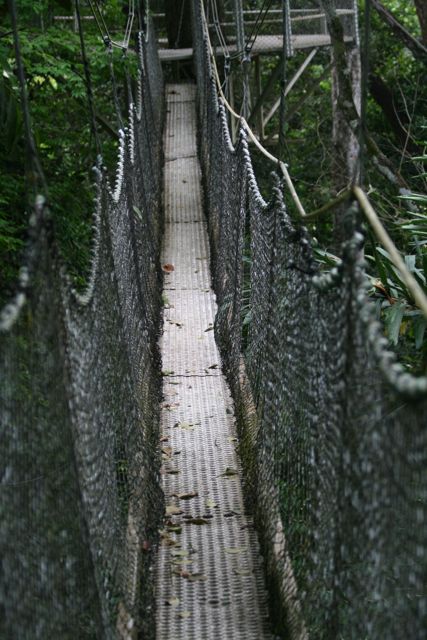
Pretty much every foreign trip has a moment that feels like Outward Bound for Zick. Maybe it's bargaining a vendor down in a crowded marketplace where nobody speaks English. Maybe it's getting everything I've bought back into my stanky suitcase for the ride home. Maybe it's just trying to make it through a day afield with dysentery. Or maybe it's having to cross narrow, swinging, slippery wet canopy walkways in an evening thunderstorm. Yeah, that's it. Crossing narrow, swinging, slippery wet canopy walkways in an evening thunderstorm.

At Atta Canopy Tower Camp, there is a system of walkways strung through the tops of forest giants, I don't know how many feet above the forest floor. It's way higher than our 42' tall birding tower, high enough to ensure that if you fell you'd be a spot of grease on the forest floor. I'd heard a lot about canopy tower walkways, but had never been on one. I'd never actually wanted to be on one. My time had come. Everybody else was going, so I did, too.

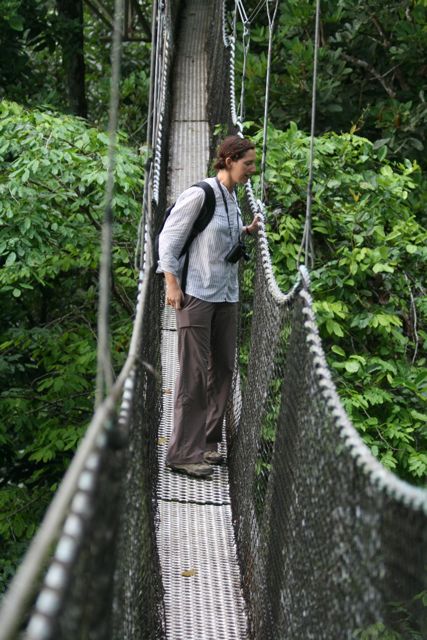
Erica tripped over them like a cat.
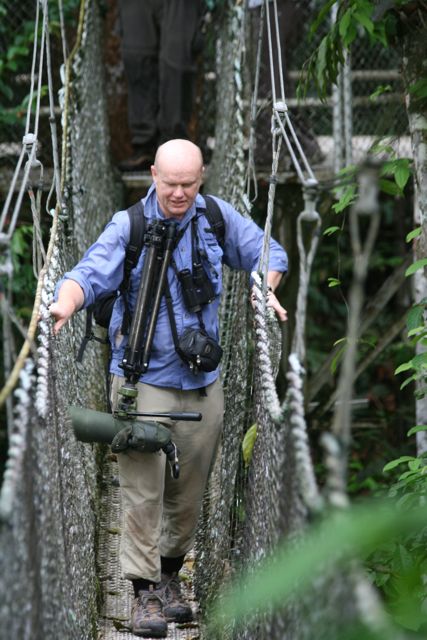
Mike was completely laden with optics and (eek!) tripod, but he gamely pressed on. He didn't enjoy it much more than I did, and I know I wouldn't have attempted it with that much luggage.
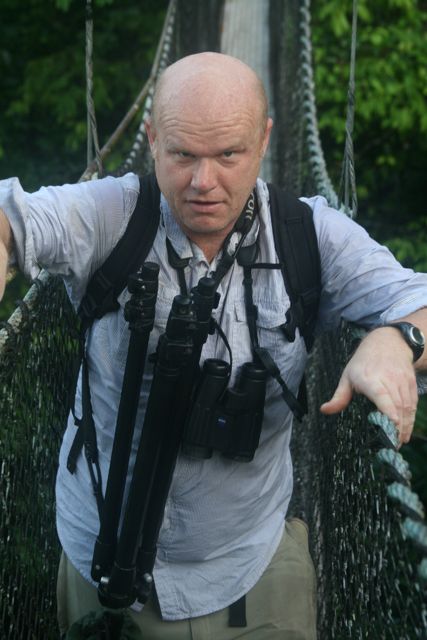
This is Weedon's I'mnothavingfunrightnow face. Nobody caught mine, thank goodness. Mike, I'm sorry. But I have so many good pictures of you I am shamelessly exploiting you without your consent. Hope that's OK.
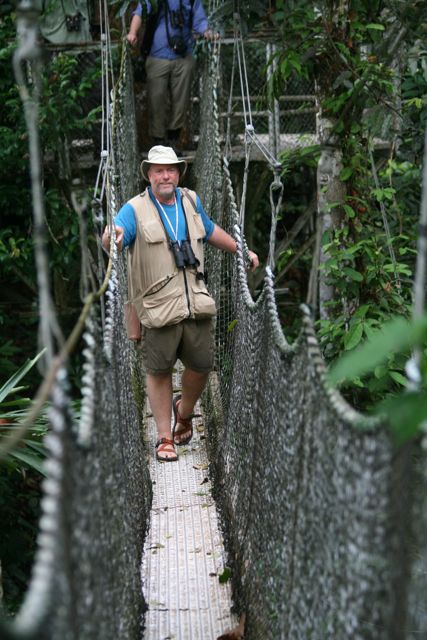
Crossing canopy walkways is all in a day's work for Kevin Loughlin. Here he comes, relaxed as rain, and also toting much photographic gear in those giant vest pockets. He's a wonderful cheerleader for the timid. (and taking trips to Guyana with Wildside Nature Tours).
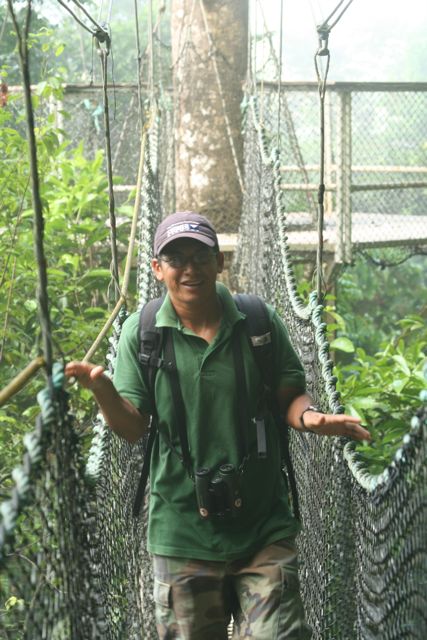
Ron Allicock was unfazed, but then he's a guide. This is what he does.
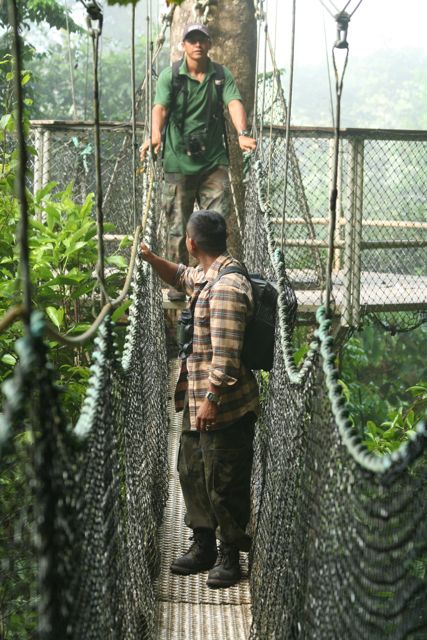
The guide in the foreground was a major designer and construction engineer of the walkway. He told me about shooting lines up into the trees, hoisting other lines, climbing with spikes and other gear, driving anchors into the trunks, all of it dangling perilously above the unforgiving earth. He walked those swinging paths with the nonchalance of a jaguar. He is made of much stronger stuff than I.
I figured out that the only way to get through it was as fast as I could, just taking one step forward at a time, then stringing those steps together into a journey. photo by Kevin Loughlin
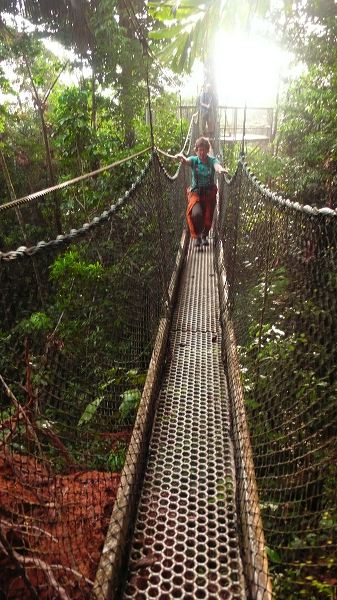
The only way forward is straight ahead. But sometimes it is very difficult.

All told we made two forays to the canopy walkways. I wish I could say we saw loads of amazing birds from there--I understand that often one does--but it rained nearly the whole time we were there and things were comparatively quiet.
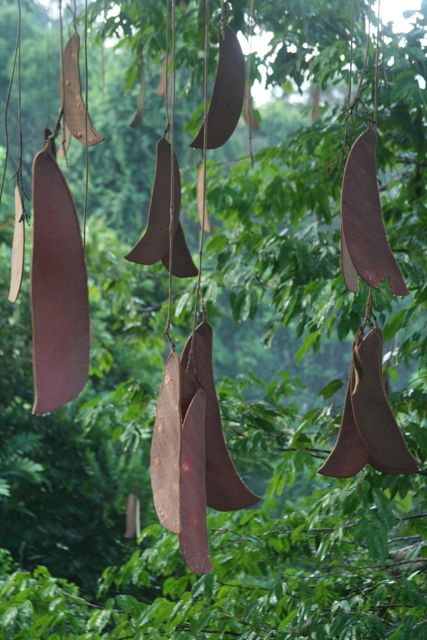
There were some very impressive pods, dangling like an interrupted phone call, which we'd never have seen from below.
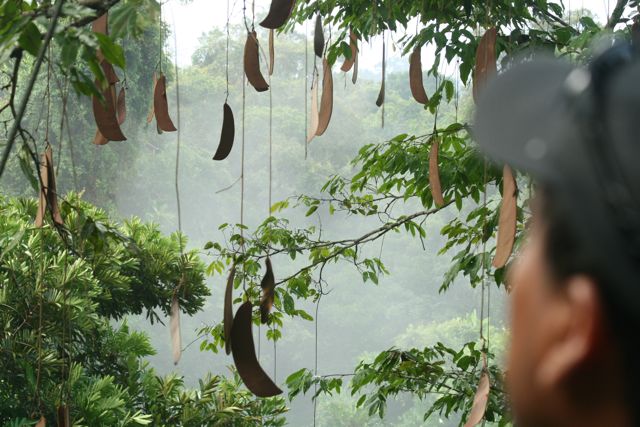
Ron told me they suddenly pop open when they're ready to shed their seeds, and the seeds go flying in all directions. Ow! Bananas gone wild.
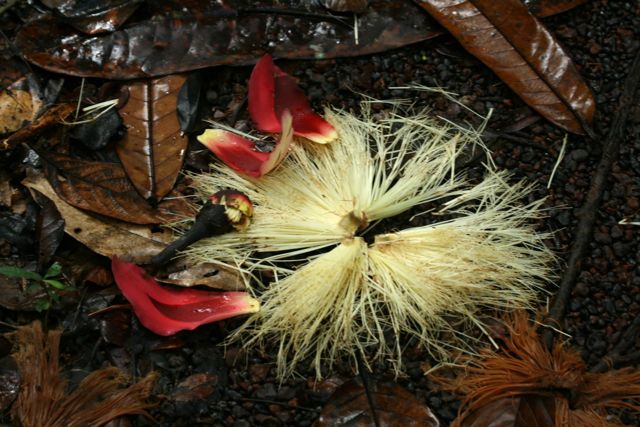
Far below, there were bits of giant exotic tree flowers, I knew not what sort.
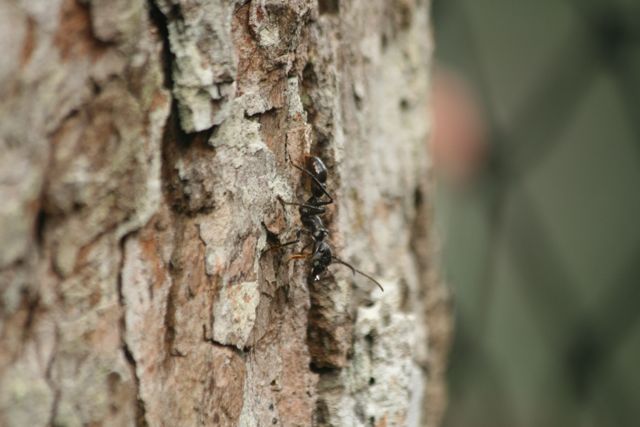
There were bullet ants on the tree trunk. The bullet ant's sting is so painful that Makushi Indians use a bullet ant bite as part of a male initiation ceremony.
For painful initiation, crossing five swinging walkways, each one longer than the last, over dizzying dark leafy heights is plenty enough for the Science Chimp. I made it, twice over.
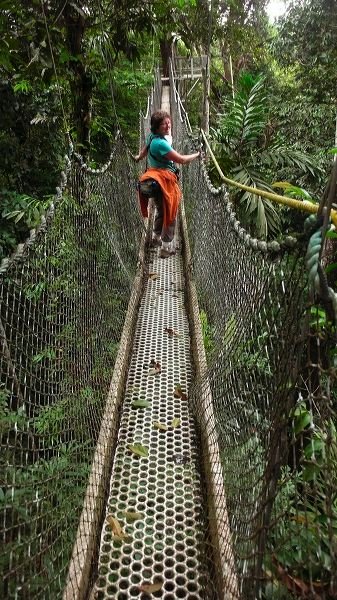
Photo by Kevin Loughlin

Posting from the Apple Store in Columbus, where my friendly geniuses have concluded that I have a major chip issue in my Mac PowerBook. It started in a downpour in Guyana and it hasn't gotten any better. She's been spontaneously shutting down and that, my friends, is a drag on the creative spirit. So I bid her adieu for five to seven days of under-warranty massage, and somehow cope with the old G-5 desktop that smells like burning wires and whines like a lonely hyena. Many thanks to Jaime and Kevin for handholding, cord-replacing (durn macaw!) and general good vibes. It's good to have Geniuses who read yer blog, especially as I descend into LAS (laptop separation anxiety).

If all goes well I will transport the semi-conscious, jetlagged carcass of Bill of the Birds from the airport safely home to Whipple this afternoon. Those of you who travel by air know how much is encoded in the phrase "if all goes well." Let's just say I left the kids with their grandparents. Could be a rough ride.

Thursday, March 12, 2009

Seeing the Harpy Eagle

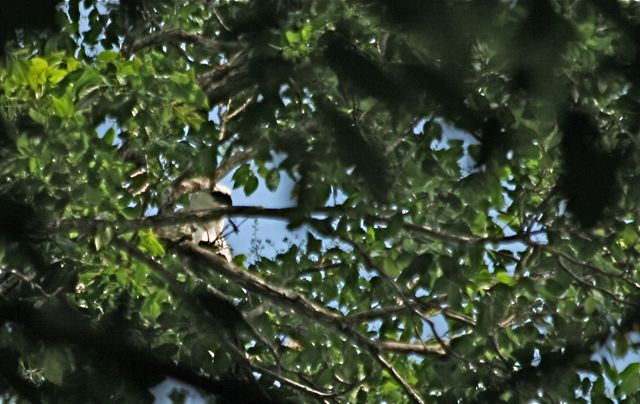
It took quite a bit of maneuvering for our skilled guides, Ron Allicock and Luke Johnson, to spot the fledgling harpy eagle perched on a branch of the ceiba, then get us into a position where we could see it, too. But it was there, it was there, and our hearts overfilled with joy at the prospect of seeing even a bit of it.

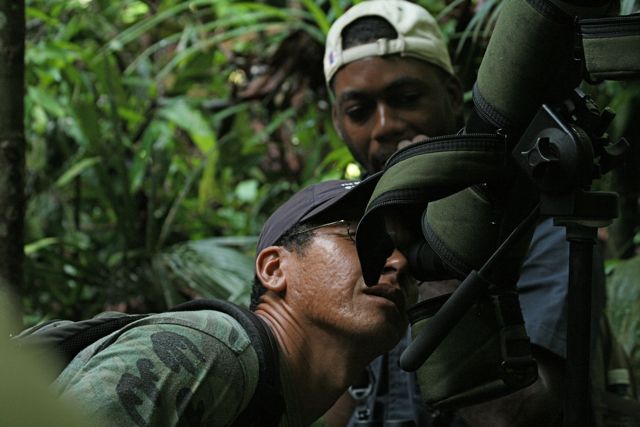
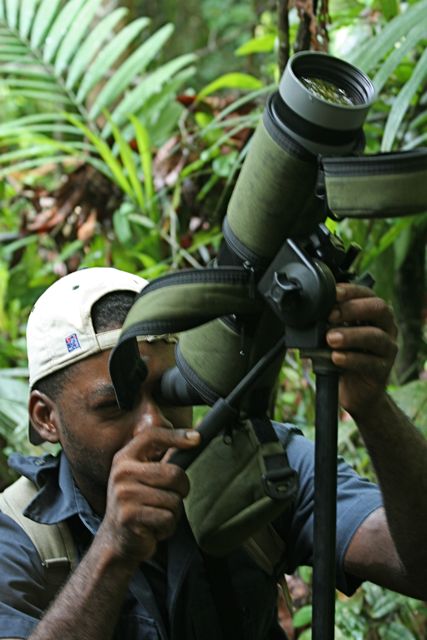
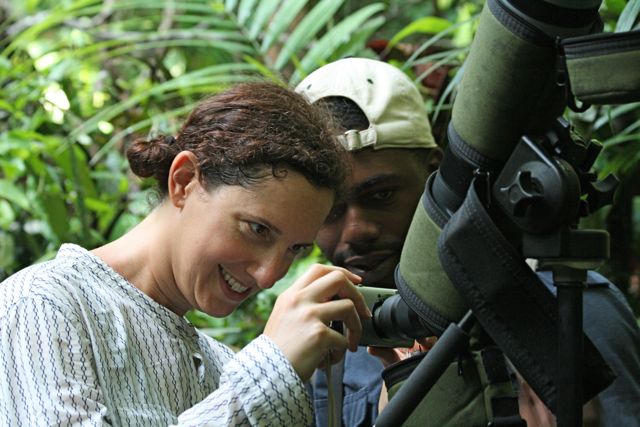
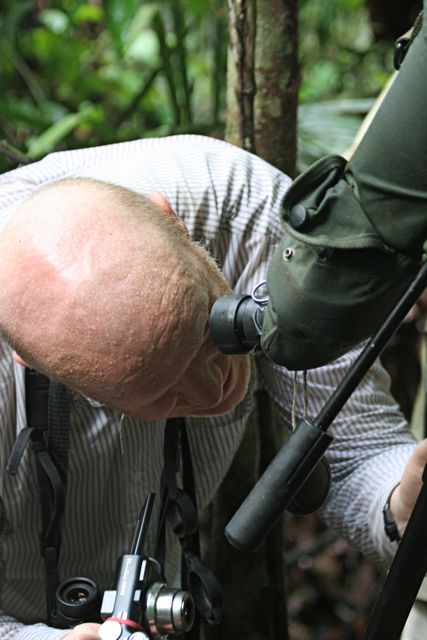
We practically bent double to get the scopes on the bird, more than a hundred feet overhead in the very top of the emergent ceiba tree.Mike Weedon gets an eyeful. Unnh!

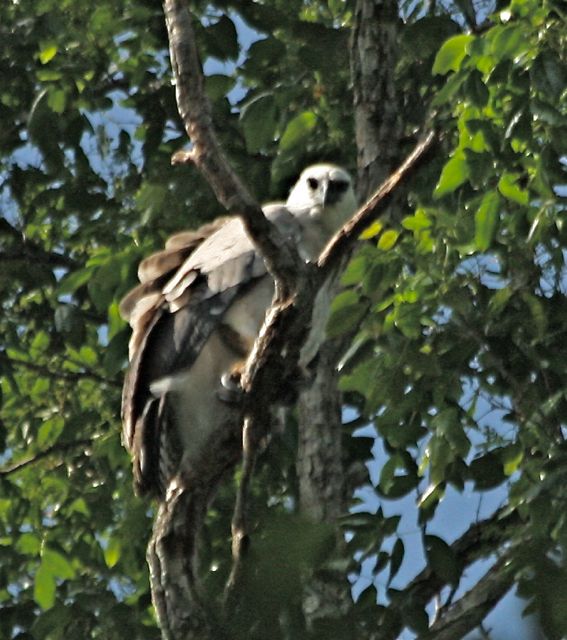
For the next forty minutes, we admired this from our contorted positions:
just the face of a young harpy. It was enough. It was wonderful. Every now and then the breeze would blow its feathers and raise its double crest and we'd sigh in admiration. We were looking at a harpy eagle, the most important bit of a harpy eagle, and a baby harpy at that.

Here's Ron Allicock, who found it for us in the first place. Obviously, the nest was a stakeout; it was a known nest, discovered when logging crews came to fell some trees in a selective cut. (The ceiba will not be cut, and the harpies are doing fine). But it takes some serious doing to see the eaglet even when you find the nest, because at the time we visited, it was trying its wings and "branching" all over the enormous tree, sometimes in view and mostly not, obscured by the canopy below the emergent tree. In fact, the second group of our tour who visited the nest the next morning missed seeing the eaglet. Let's have a moment of silence for those hopeful birders. No gloating here.


But Luke wanted more for us, so he and another expert guide set quietly off through the jungle to try to find a better vantage point.


And find it they did.
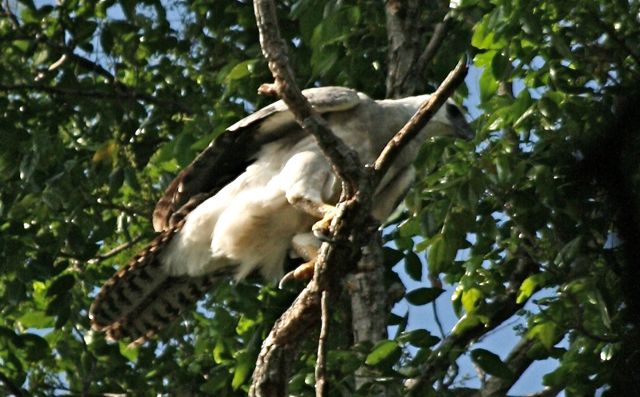
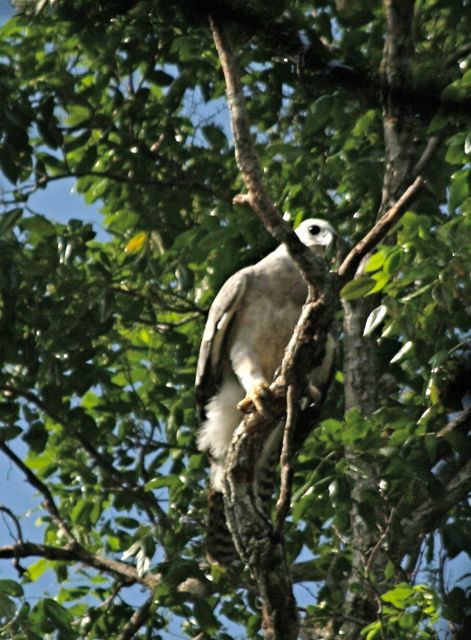
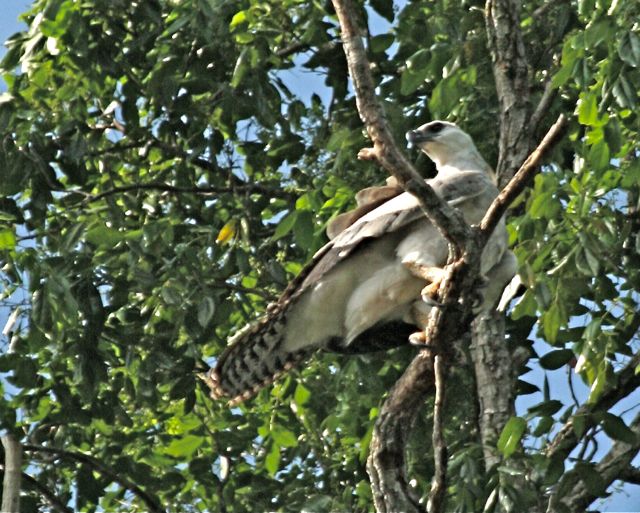
O.M.G. Now we had not just the head, but the whole enchilada, fluffy harpy eaglet bloomers, massive talons and all. Whooooooo.

The eaglet noticed.

But it preened and seemed fairly unconcerned about these primates far below which were after all too large to practice upon.


Harpy eaglets apparently come one to a nest. Though two eggs are laid, the second is abandoned as soon as the first hatches, and all the parents' focus goes to raising the sole princeling or princess. A harpy eaglet stays in the vicinity of the nest and in the care of its parents for a year or more, waiting for the occasional sloth/monkey to be airflighted in, and growing stronger until it's ready to try its six-foot wings and catch its own prey. With a reproductive rate like that, it's no wonder this apex predator is so rare.

Luke watches Erica get her camera lined up to digiscope the eaglet.
And the eaglet looks right back.

We quietly withdrew, grateful for this audience with a mythic bird.

Keep growing and thriving, prince or princess, whichever you be. Thank you, Surama Eco-Lodge, thank you Ron Allicock and Luke Johnson, US AID and the Guyana Sustainable Tourism Initiative, for taking us to the nest of the great forest harpy. I am grateful to be able to share the experience with so many people, and hopeful that one harpy eagle is ultimately worth more to the people of the area than many, many fallen logs.

Go see. Give Guyana, its giant otters, its potoos and giant anteaters and harpy eagles some of your travel budget if you can. It will not disappoint.

Back here on earth, I will be speaking and showing my paintings at the Riverside Artists' Cooperative Gallery, 188 Front Street, Marietta, Ohio 45750 at 6 pm on Friday, March 13. For more information please call (740) 376-0797. And don't forget to blurt "BLOG" when you introduce yourself!

Wednesday, March 11, 2009

Harpy Eagle: Nightmare on Wings

We were looking for Harpia harpyja, perhaps the largest eagle in the world, rivaled only by the Philippine (monkey-eating) eagle, a species that someone I love very much is trying, hiking, stumbling to see as you read this. Kind of romantic...we have both searched for the world's largest eagles on opposite sides of the world. It's romantic until you realize that we have to be apart an awful lot to do that.

These mega-eagles take large prey--monkeys, small deer, opossums, coatis--and can flip upside down in flight and rip a sloth right off its perch. If you've ever tried to remove a sloth from something it's hanging on to, you know how strong they are. Harpy eagles are stupefyingly powerful. In Greek mythology, the harpies were those horrid winged women with their breasts hanging out who swooped down to take you to the underworld. Shudder. I like it when mythology and taxonomy collide; it makes for colorful names.

To give you an idea just how big this bird is, here is Neil Rettig, filmmaker, falconer and arguably the world's authority on the species, holding a captive bird. Rettig was the first person to make a study of them at the nest, building and living in scaffolding, and producing unforgettable photographs and film of their family life for National Geographic. What an honor it was to meet him and his glorious eagle, in Davenport, no less!


I shot these photos at the Midwest Birding Symposium in Davenport, Iowa in October 2005. Get a load of those talons; compare them with Neil's fingers. Note that he has to support his arm with its heavy leather gauntlet to keep this enormous bird comfortable (and keep his arm from falling off). This bird can weigh 14-20 pounds (Chet Baker weighs 24 pounds).

The harpy's rounded wings (see, no primaries extend from beneath the broad secondaries) help it maneuver in tight spaces, much as do those of the accipiters, only on a huge scale. The long, heavy tail is a good rudder for fast turns. A harpy's feet are almost cartoonish; I remember thinking that the first time I saw one perched along Brazil's TransAmazon Highway in 1979. They looked as though they'd been inflated. The better to squeeze a wooly monkey, my dear. I cannot imagine trusting one with my right arm, even through a leather gauntlet. (Says the woman who handed a giant Amazon otter a chance to crush her wrist...)

I have been reading some excellent books on falconry lately, by Rachel Dickinson (Falconer on the Edge) and Tim Gallagher (Falcon Fever). I wish I had read them before I met Neil. I would have asked him where he takes this bird to fly it; what kind of prey they look for. Woodchucks? Rabbits? Egad.

People get rather complacent around birds of prey when they are sitting calmly on a handler's arm. When the harpy suddenly sleeked and focused, I automatically followed its gaze to see what had interested it, and was horrified, at the receiving end of that laser glare, to see a wriggling infant being wheeled into the auditorium in a stroller. Nothing escapes an eagle's attention; it may be above acknowledging most things, but you can be sure it noticed. I don't think anyone in the room but Neil and yer blogger caught what was going down in the eagle's brain...I could read its thoughts. Good thing the baby's parents couldn't.

Right prey size class, check, defenseless, check, very manageable, check, big sturdy rafters I could bear it away to, check...keep your hand on those jesses, Neil. And, knowing his harpy and certainly needing no input from me, he had already tightened his grip.

I would not bring a poodle into this auditorium. And I would want to know when Neil was flying his harpy eagle, and leave Chet Baker home.


Next: Looking for the Wild Harpy

Tuesday, March 10, 2009

The True Identity of Woody Woodpecker

Gentle listeners:
I'm on near the end of the second hour of National Public Radio's All Things Considered today, March 10, probably around 5:45pm ET. I'll be talking about the True Identity of Woody Woodpecker, with sincere thanks to ornithological superstars Alvaro Jaramillo and Kimball Garrett. If you miss it on air, you can read it, and listen to it after 7 PM ET, here.

This was probably the most difficult piece I've ever written or delivered--eight takes?? Over two hours in the studio for a three minute piece? Laughing like a maniacal cartoon character oh, twenty times? You'd never know to listen to it...I hope.

And now scroll down for our regularly scheduled natural history post. Thank yew.

Harpy Eagle Nest

One of the ornithological highlights of my year was a trek to see the nest of a harpy eagle near Surama Eco-Lodge. There are around 200 known harpy eagle nests in the bird's entire range. Looking down on the unbroken green carpet beneath our airplane or from a promontory, I would imagine and hope that there are more than 200 nests on the planet, but that number serves to give you an idea just how rare an opportunity this would be.

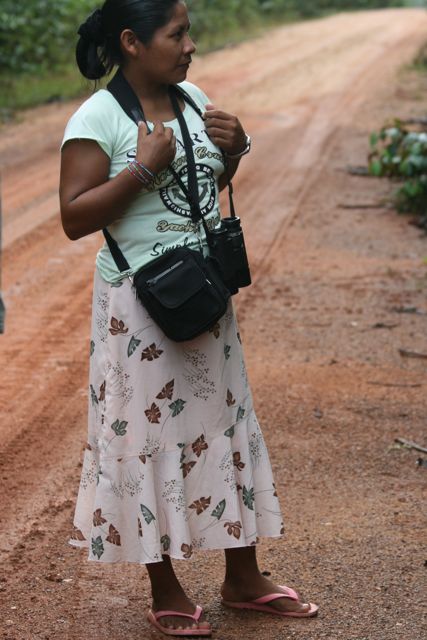
I was glad to see the trail not well-maintained or easily traversed. In fact, walking it was like doing hundreds of leg-lifts as we hopped, stepped and scrambled over log after fallen log. Add a few dozen pounds of camera and optical gear, hike the temperature to about 98 and the humidity to God knows where, and it was like doing aerobics in a sauna. In contrast to those of us who were sweating through our layers of protective clothing, getting funkier by the minute (at 7 AM, no less!) one local birder looked perfectly comfortable. Beautiful, in fact.

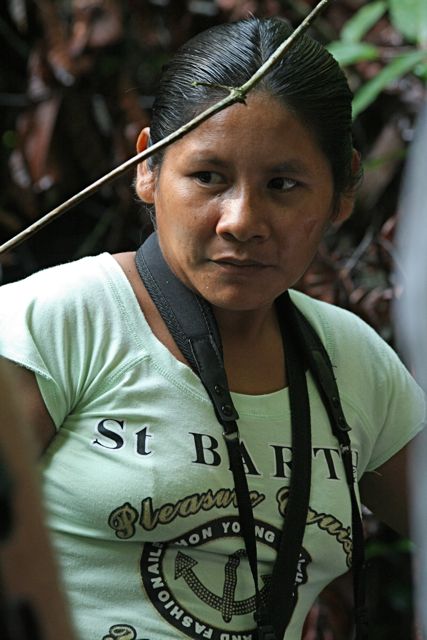
I will never cease to marvel at anyone who can navigate tropical lowland forest in a filmy butterfly skirt and flip-flops. I would be convinced that something unknown would run up my leg, or that I'd be impaled on one of the billions of spikes and thorns with which all tropical vegetation bristles. And surely it would, and I would.


She made it just fine. This is her habitat, and with every cell of her body she is adapted to it as surely as I am to the slippery hills and hollers of Appalachian Ohio. I love looking at people just like I look at animals, seeing us as part of an evolutionary continuum and not something set apart. It's OK to do that, whatever the traditional Christian view tells us about our apartness, our supposed dominion over the fish and fowl and beasts. I don't buy it. In my view, we're much more a cog in a big, beautiful machine than the operator of said machine. Mostly, it seems, we're here to mess it up. We throw an ecological wrench into the works every day, every chance we get, but in the end, we're a tiny moving part in a much greater whole. This is a truth she knows in her bones. It is one that most of the rest of us are never able to grasp. And the spikes and the spines seem to part before her, and they tug at our sleeves.

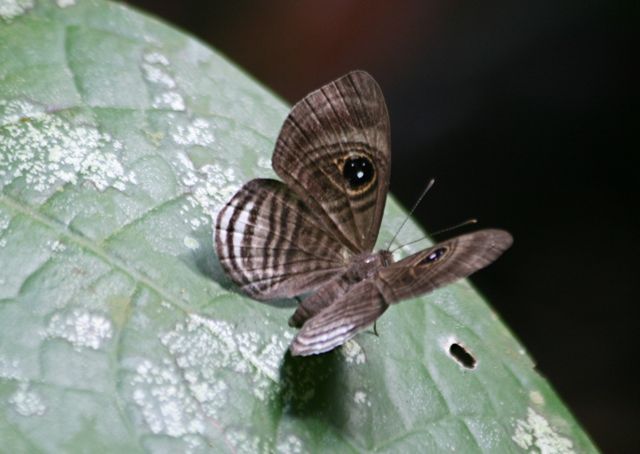
There was so much to look at, but the hike was almost two miles, and we had to keep moving. This little nymph reminded me of some of our satyrs back home.
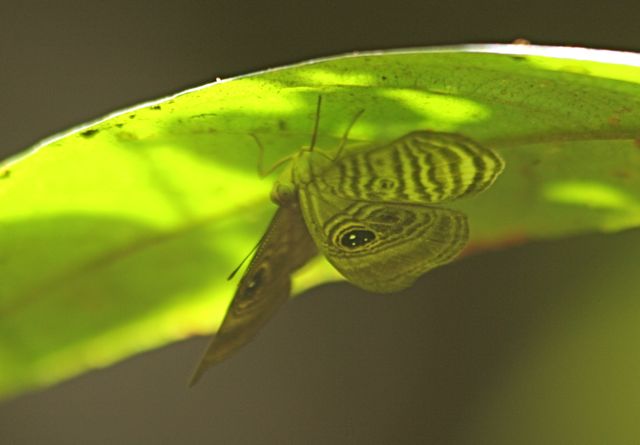
Finding itself observed, it quickly flitted to hang upside down on the underside of a leaf.
There's so much hiding going on all the time; if it's not cryptic coloration it's cryptic behavior like this. And eyespots to startle and confuse as well.


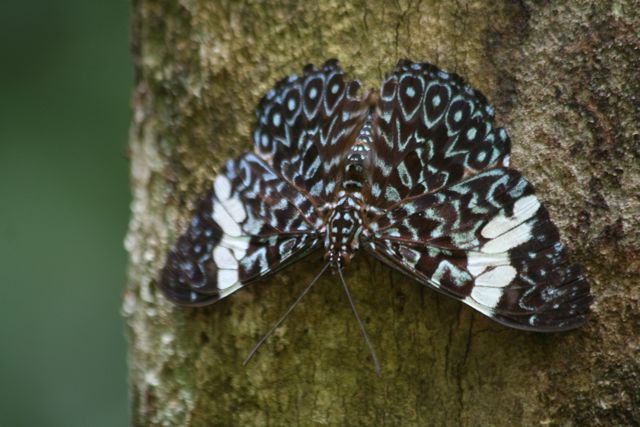
This is one of the cracker butterflies, so called because its wings snap loudly when it takes off. Crackers like to hang head-down, ready for anything. Kevin Loughlin said this one reminded him of a species called starry night cracker. What a lovely name, even if it's not the right one. Once again I had to be content with getting close, without the satisfaction of a taxonomic cigar.

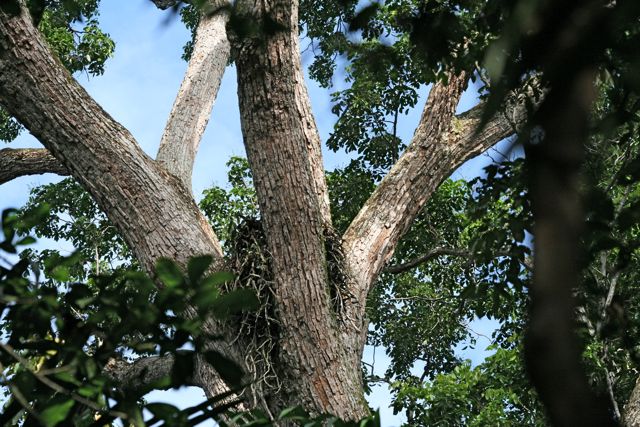
For the entire hike, I kept myself occupied with the wondrous things all around me, careful not to become so focused on seeing a harpy eagle that the trip would be ruined without reaching that goal. But when the nest finally hove into sight, all those resolutions crumbled. I desperately wanted to see the bird that made this huge pile of sticks, or perhaps the eaglet who came out of it.It's hard to convey just how huge this tree, this nest, really was. Harpies often choose to nest in ceiba trees, the largest emergents in most lowland forest, and a tree that, by some incredible grace, is often revered enough that it is considered bad luck to cut them. Whether that is connected to the fact that it's the tree preferred by nesting harpies, I am left to wonder. I remain wary of the apparent charity of man: traced to its roots, it is usually revealed to be self-serving. Whatever the reason, this ceiba survived the cutting, and the powerful birds who call it home were allowed to stay. It bothers me that we, avaricious and destructive primates that we are, are endowed with the power to grant such a thing.

Next: A harpy eagle, up close and a little too personal.

Monday, March 9, 2009

Great Big Freaky Bug

Surama Eco-Lodge is the sweetest little place. How I wish it hadn't poured like monkeys the whole time we were there, for we had to forego our afternoon hike. It's nestled in fabulous habitat next to the mountain range, and you can see tons of great birds and animals there. Once again, the food was terrific, the hosts warm and knowledgeable.

Erica and I took a good long nap, to the sound of rain on the tin roof. It was delicious, as was dinner. Man, Guyana had such good food--lots of fresh vegetables, beans and rice, and chicken in savory sauces. It may not have been flashy, but it was just what I needed.

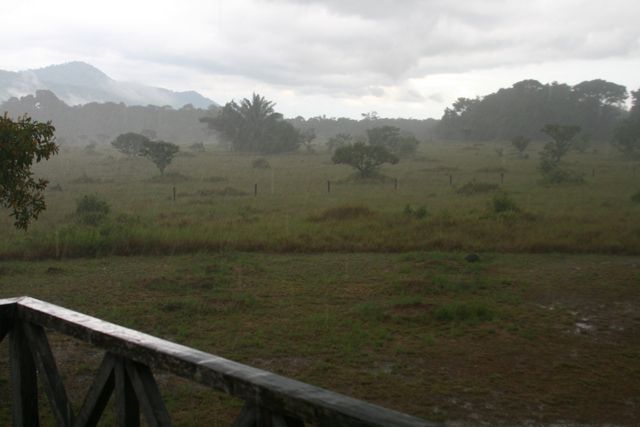
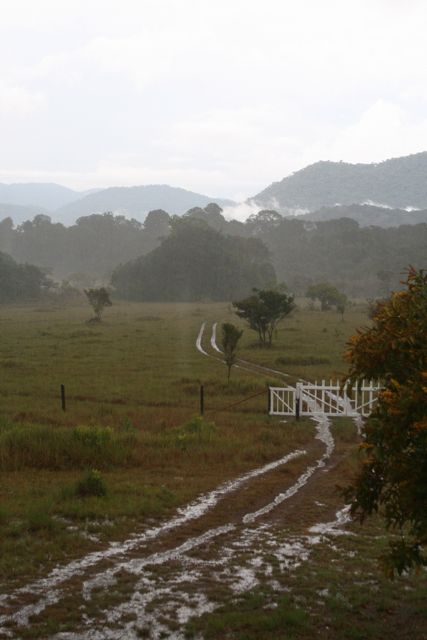
I love this shot, the road stretching like a lighted path to the mountains. I could only imagine what birds we might have seen there. I want to go back.
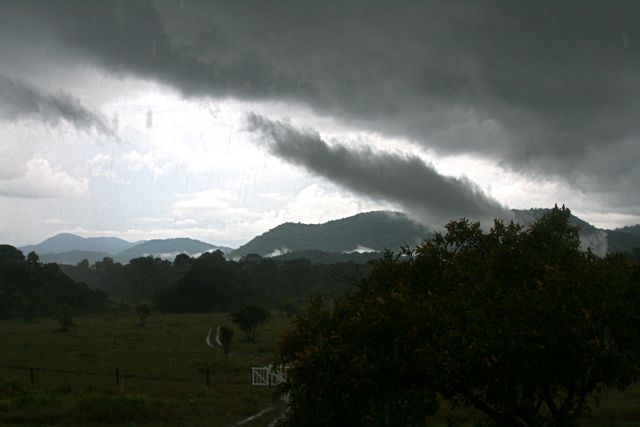
Just before dark there was a break in the rain, and these clouds came scudding across the landscape. One, like the tail of a giant anteater diving into the trees. I don't think I've ever seen a cloud quite like that back home.
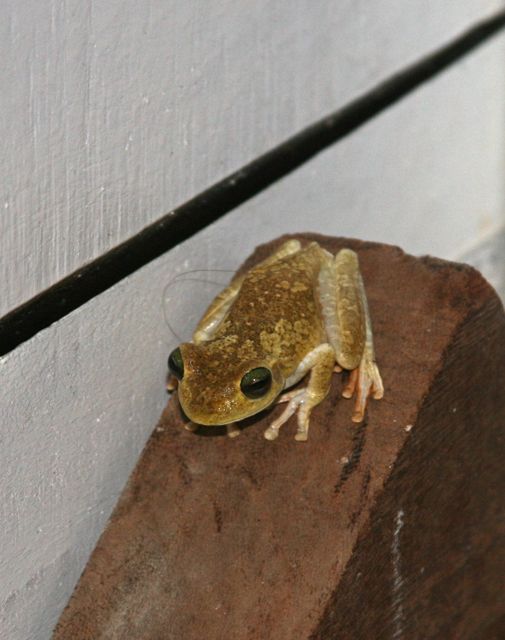
You may be sure our group of curious naturalists found ways to amuse ourselves. For one, there was a House Frog.
He was on duty for roaches, crickets, katydids and spiders, and most welcome. Just don't land on my face in the night and we're good.

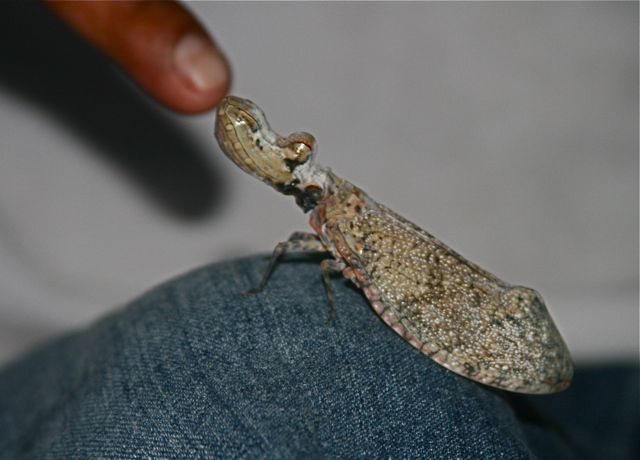
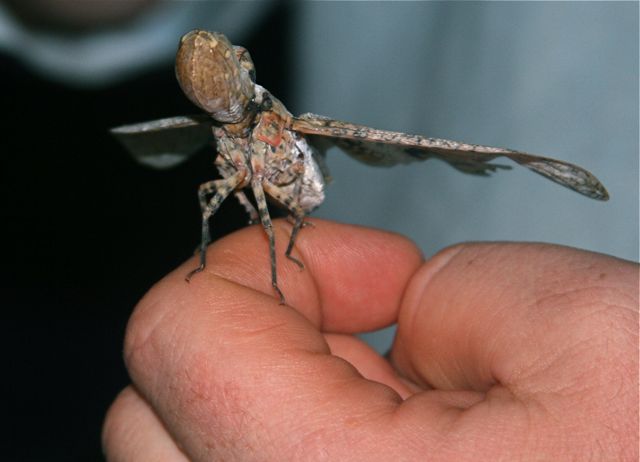
I wonder what he would have done with this--my first ever lanternfly Fulgora laternaria.
I was BESIDE MYSELF. I'd read about this beast all my life, had always wanted to see it in the most eager, Science Chimpy way. (Thank you, DOD, for keeping us in National Geographic our entire childhood. I believe that magazine changed my life.) The head looks so much like a caiman that it flips me out; it's a beautiful example of the intelligence of evolutionary design. Yes, you read me right. And I am messin' with your head.
I mean, look how the "eye" is reflective, just as it would be if the lanternfly really were a winged lizard.

The eyes of the creature are the two dark spots on the "caiman's" neck. So the peanut-shaped fright mask is actually a headdress or helmet. Pretty cute, when you look at it that way. Like a pope's hat. It was originally thought to be luminescent, hence the name lanternfly. Believe it or not, this is just an overgrown planthopper. Splendidly, magnificently, over the top-tropically overgrown.

Here's the WW II bomber, preparing for takeoff...

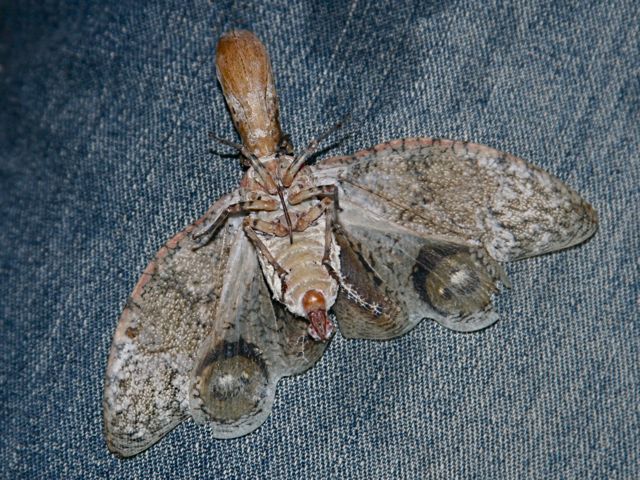
Messing with it a bit, we got it to spread its wings. It jumped and fell, oops! giving us its ventral view, which looked an awful lot like a cicada to me. You can see the sucking mouthparts, the dark tube running down between its legs. Again, very cicada-like. It just drinks plant juice, that's all, and is perfectly harmless to people.


This thing has the defenses! Look at those eyespots on the underwings. So if it can't scare you with its gatorhead hat, it flashes big owl eyes at you. It must be quite delicious to invest so much in scaring away potential predators.


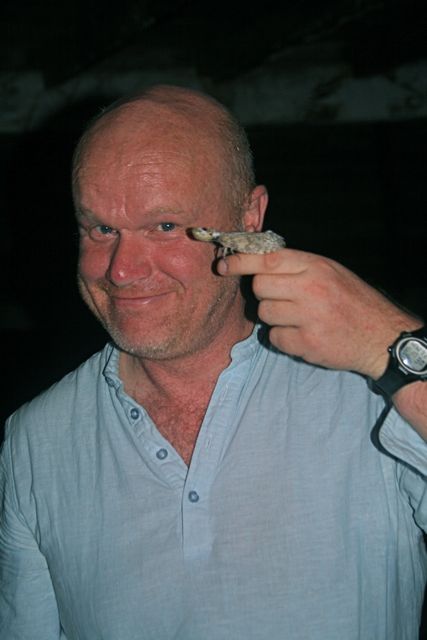
Big bug. Mike Weedon looks terrified. Looks dangerous, but the only problem with it is that legend has it if you're bitten by the machaca, you have to have sex within 24 hours or die badly. Thank God no one was bitten. The pool of candidates was rather small; everybody was married or otherwise committed, and it was so disgustingly hot and humid that, well, let's just say it was not an aphrodiasical environment. I felt like a slimy toad the whole time. Had it bitten me, I might have had to just go ahead and die.

Sunday, March 8, 2009

Tommy the Tapir

I'm home from Honduras as of Friday afternoon. Moving slowly through the house, tossing and filing a month's worth of spoiled food and clutter, scrubbing away the domestic snarge, wearing my Life is Crap T-shirt, a gift from Liz and Jeff.  Two thousand exposures made in Honduras await editing. Taxes await finishing. There's a woodcock singing in the meadow at dawn and dusk and I am pulled in a hundred directions on the sweet rack of springtime. Shall I plant the peas or scrub the sink, crouch in thrall to the peepers or tally expenses? Yeah, yeah, I know what I should do. 

Everything. 

Thank goodness I canned some Guyana posts before leaving for Honduras. Even some Cute Animal Posts. I bring you Tommy the Lowland Tapir.

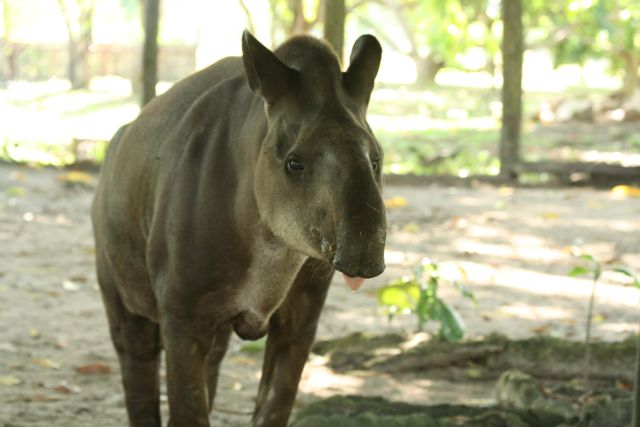
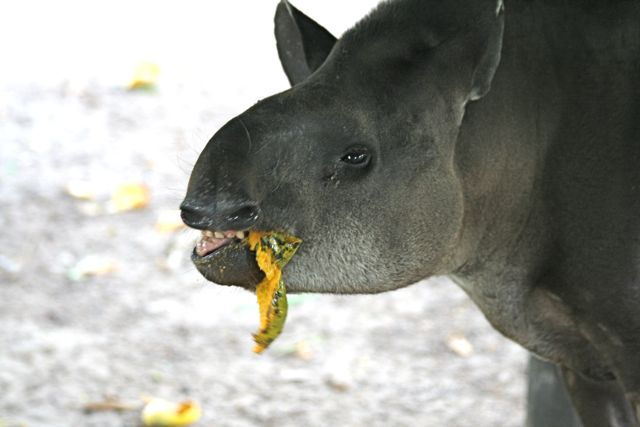
A new mammal--the lowland tapir Tapirus terrestris, awaited me at Rockview Lodge's modest zoo. I would not be lucky enough to see one in the wild, but Tommy's fame preceded him. He's been living as a pet at Rockview for twenty years or more; tapirs may live past thirty.

Tapirs are weird, weird animals. There are only four species worldwide; three of them are in Central and South America (the Baird's, lowland and mountain tapirs), where they're the largest land mammals. A fourth, the largest, is the Malayan tapir--the black one with the big white band around its middle.

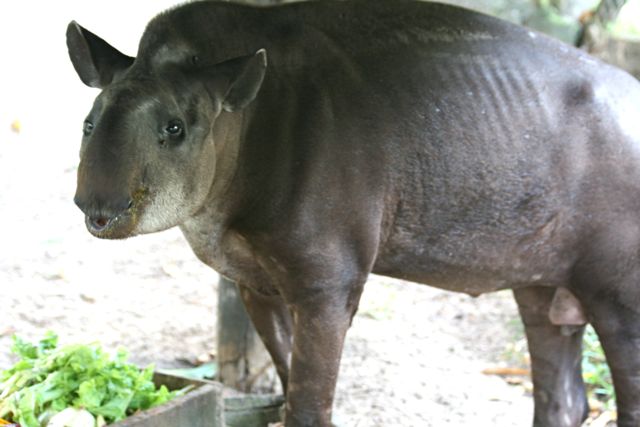
The lowland tapir is slightly smaller than the Baird's tapir, which ranges through Central America. Lowlands take over in South America, and are characterized by a little mane and nuchal (neck) crest. They grow up to six feet long, 550 pounds. That's a lot of tapir.

Something like a horse, something like a pig, nothing like either, the tapir has a dense, muscular body and an extremely tough hide, which helps protect it from jaguar and puma attacks. Its main defense strategy is to run like hell, hoping to bash its attacker off against a tree in the process. It swims readily and well, and often spends hot days (are there any other kind in Guyana?) almost wholly submerged, when its prehensile snout comes in handy as a snorkel. They probably get pretty pruny.

Tapirs look completely prehistoric to me; they look like a reconstructed ancient weird mammal come to life. Like they were put together before evolution really had its act together. Like their name should be Uintatherium.


In the wild, tapirs subsist on fruits and leaves, traveling from fruiting tree to tree, looking for dropped treasures. They're a great disperser of many different kinds of seeds, being large enough to pass them whole.

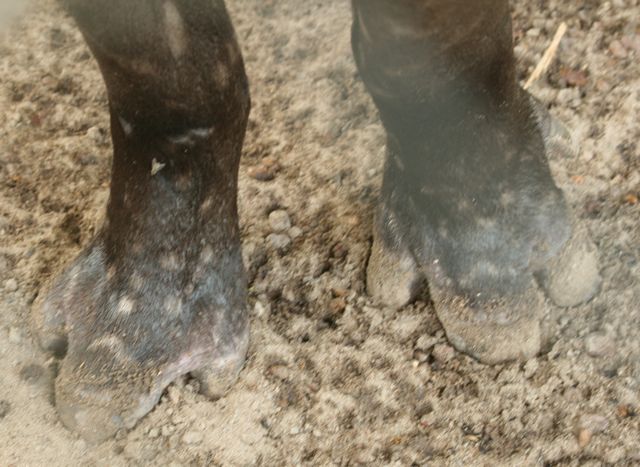
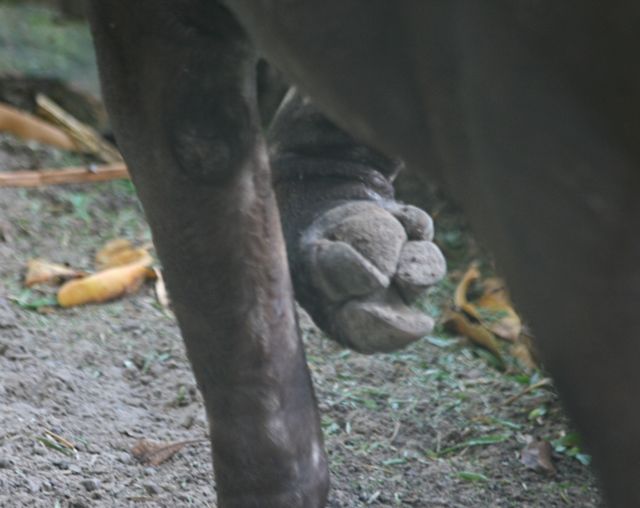
Baby tapirs are striped and speckled like baby hogs or watermelons, the same kind of dappling that helps hide fawns when their mothers leave them alone in the forest. I loved Tommy's front feet--four-toed and --there's that word again--prehistoric, the kind of feet Eohippus had. You can see remnants of his baby spotting on his lower legs and feet, even though Tommy is a very old tapir.
Get a load of the underside of his foot. Ooh, paddy.


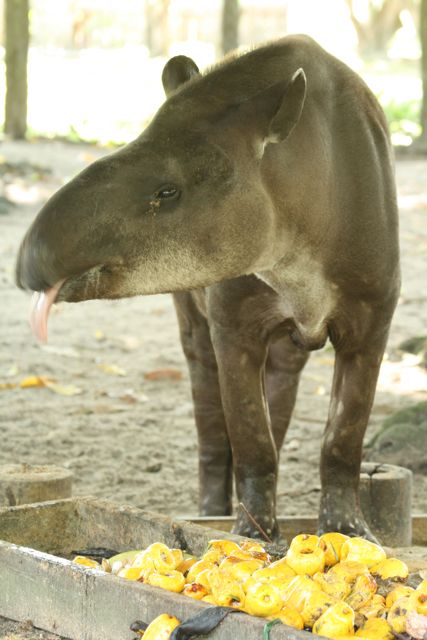
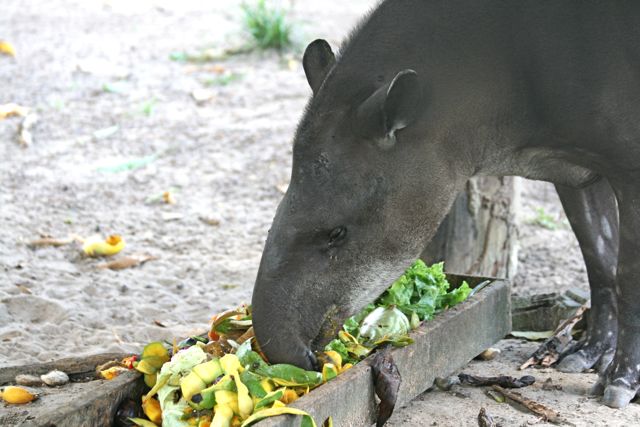
It takes a whole lot of mangoes to keep Tommy happy. Good thing there are enormous mango trees, each covering the square footage of your average American house, shading the grounds of Rockview Lodge. It makes feeding slobbery Tommy a lot easier.
He rooted around happily in his salad, looking first for the ripe mangoes. He'd finish the rest later.
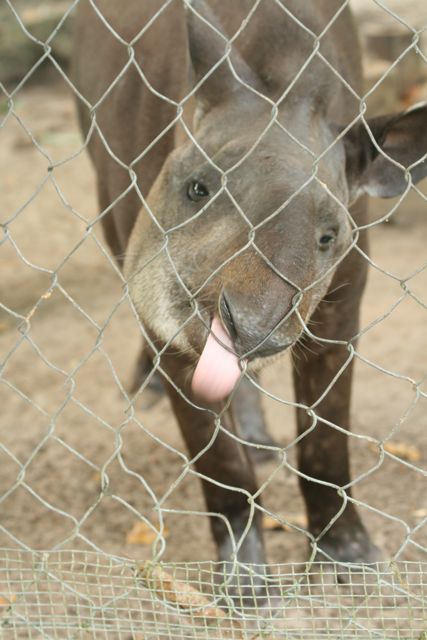
Tommy was extremely sweet, and obviously enjoyed the attention my friend Erica and I heaped on his leathery hide. His lickiness was  familiar and comforting to a Chet-starved Zick, who needs to be covered in some kind of animal slobber at all times to feel whole.
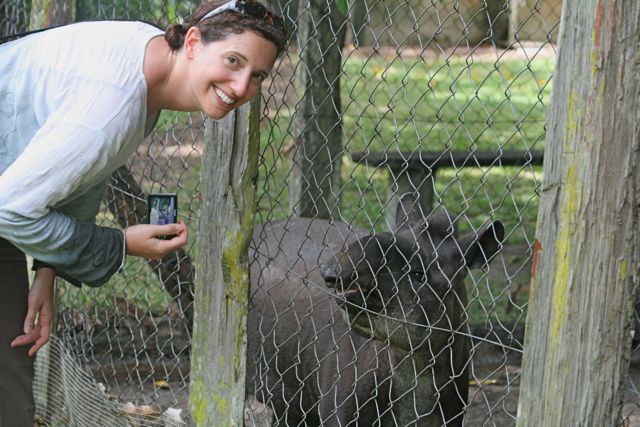
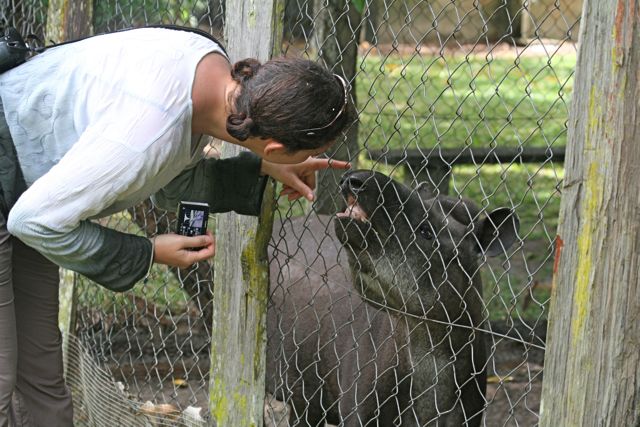
Erica and I were very well-matched as traveling companions--it was a dead heat as to which of us was more animal crazy. Here, she meets Tommy for the first time.

Later, Erica got to go in the pen with Tommy and give him proper tapir huggin'. 

I was out after nighthawks and cloud formations at that point, but man, I would have loved to put a big hug on Tommy. He is a fine and handsome gent, a good ambassador for an endangered species. Meet a tapir, and you'd hate to see them poached for food or hide. But the killing goes on, and all four species of tapirs worldwide are now endangered. It is as if they are from another time, a wilder, gentler time than ours.
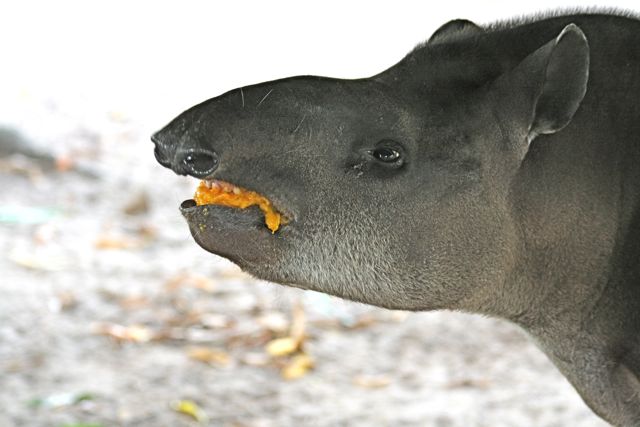
Prehistoric, tapir time.